Advertisements
Advertisements
प्रश्न
(i) State Bohr's quantization condition for defining stationary orbits. How does the de Broglie hypothesis explain the stationary orbits?
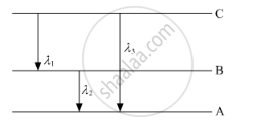
(ii) Find the relation between three wavelengths λ1, λ2 and λ3 from the energy-level diagram shown below.
Advertisements
उत्तर
(a) Bohr's quantisation condition: According to Bohr, an electron can revolve only in certain discrete, non-radiating orbits for which total angular momentum of the revolving electron is an integral multiple of `h/(2pi)`where h is the Planck's constant.
`:.mvr=(nh)/(2pi)`
(b) Using the Rydberg formula of the spectra of hydrogen atom, we write
`1/lamda_1=R(1/n_(2^2)-1/n_(3^2)) ......(1)`
`1/lamda_2=R(1/n_(1^2)-1/n_(2^2)) ......(2)`
`1/lamda_3=R(1/n_(1^2)-1/n_(3^2)) ......(3)`
Adding (1) and (2), we find that
`1/lambda_1+1/(lambda_2)=R(1/n_(1^2)-1/n_(3^2))=1/lambda_3`
This is the required relation between the three wavelengths.
संबंधित प्रश्न
Using Bohr's postulates, derive the expression for the orbital period of the electron moving in the nth orbit of hydrogen atom ?
According to the Bohr theory of H-atom, the speed of the electron, its energy and the radius of its orbit varies with the principal quantum number n, respectively, as:
The ratio of the ionization energy of H and Be+3 is ______.
Taking the Bohr radius as a0 = 53 pm, the radius of Li++ ion in its ground state, on the basis of Bohr’s model, will be about ______.
The ground state energy of hydrogen atoms is -13.6 eV. The photon emitted during the transition of electron from n = 3 to n = 1 unknown work function. The photoelectrons are emitted from the material with a maximum kinetic energy of 9 eV. Calculate the threshold wavelength of the material used.
The number of times larger the spacing between the energy levels with n = 3 and n = 8 spacing between the energy level with n = 8 and n = 9 for the hydrogen atom is ______.
A 100 eV electron collides with a stationary helium ion (He+) in its ground state and exits to a higher level. After the collision, He+ ions emit two photons in succession with wavelengths 1085 Å and 304 Å. The energy of the electron after the collision will be ______ eV.
Given h = 6.63 × 10⁻³⁴ Js.
According to Bohr's theory, the radius of the nth Bohr orbit of a hydrogen like atom of atomic number Z is proportional to ______.
Write the ionisation energy value for the hydrogen atom.
Energy and radius of first Bohr orbit of He+ and Li2+ are:
[Given RH = −2.18 × 10⁻¹⁸ J, a0 = 52.9 pm]
