Advertisements
Advertisements
प्रश्न
Calculate the magnetic dipole moment corresponding to the motion of the electron in the ground state of a hydrogen atom.
Advertisements
उत्तर
Mass of the electron, m = 9.1×10⁻³¹kg
Radius of the ground state, r = 0.53×10⁻¹⁰m
Let f be the frequency of revolution of the electron moving in ground state and A be the area of orbit.
Dipole moment of the electron (μ) is given by
μ = niA = qfA
`= e xx (me^4)/(4∈_0^2h^3n^3)xx(pi^2n^2)`
`= (me^5xx (pir^2n^2))/(4∈_0^2h^3n^3)`
Here,
h = Planck's constant
e = Charge on the electron
`epsilon_0` = Permittivity of free space
n = Principal quantum number
`therefore mu = ((9.1xx10^-13)(1.6xx10^-19)^5xxpi xx(0.53xx10^-10)^2)/(4 xx (8.85xx10^-12)^2xx(6.64xx10^-34)^3xx(1)^3`
= 0.000917 × 10-20
= 9.176 × 10⁻²⁴ A-m25
APPEARS IN
संबंधित प्रश्न
(i) State Bohr's quantization condition for defining stationary orbits. How does the de Broglie hypothesis explain the stationary orbits?
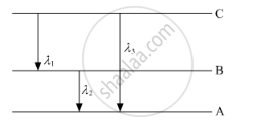
(ii) Find the relation between three wavelengths λ1, λ2 and λ3 from the energy-level diagram shown below.
Find the frequency of revolution of an electron in Bohr’s 2nd orbit; if the radius and speed of electron in that orbit is 2.14 × 10⁻¹⁰ m and 1.09 × 10⁶ m/s respectively. [π= 3.142]
How many electrons in an atom may have the following quantum numbers?
n = 3, l = 0
Using Bohr’s postulates, obtain the expression for the total energy of the electron in the stationary states of the hydrogen atom. Hence draw the energy level diagram showing how the line spectra corresponding to Balmer series occur due to transition between energy levels.
The difference in the frequencies of series limit of Lyman series and Balmer series is equal to the frequency of the first line of the Lyman series. Explain.
In which of the following systems will the wavelength corresponding to n = 2 to n = 1 be minimum?
How are various lines of Lyman series formed? Explain on the basis of Bohr’s theory.
The dissociation constant of a weak base (BOH) is 1.8 × 10⁻⁵. Its degree of dissociation in 0.001 M solution is ____________.
For an electron in the second orbit of hydrogen, what is the moment of momentum as per the Bohr's model?
Which of these statements correctly describe the atomic model according to classical electromagnetic theory?
According to Bohr's model of hydrogen atom, an electron can revolve round a proton indefinitely, if its path is ______.
Using Bohr's postulates derive the expression for the radius of nth orbit of the electron.
Hydrogen atom has only one electron, so mutual repulsion between electrons is absent. However, in multielectron atoms mutual repulsion between the electrons is significant. How does this affect the energy of an electron in the orbitals of the same principal quantum number in multielectron atoms?
For the ground state, the electron in the H-atom has an angular momentum = h, according to the simple Bohr model. Angular momentum is a vector and hence there will be infinitely many orbits with the vector pointing in all possible directions. In actuality, this is not true ______.
Use Bohr's postulate to prove that the radius of nth orbit in a hydrogen atom is proportional to n2.
The number of times larger the spacing between the energy levels with n = 3 and n = 8 spacing between the energy level with n = 8 and n = 9 for the hydrogen atom is ______.
A hydrogen atom in its first excited state absorbs a photon of energy x × 10-2 eV and exited to a higher energy state where the potential energy of electron is -1.08 eV. The value of x is ______.
State the Bohr's postulate of angular momentum of an electron.
What happens to an electron revolving in a circular orbit according to classical electromagnetic theory?
What are the atom's stationary states?
