Advertisements
Advertisements
प्रश्न
Derive an expression for the frequency of radiation emitted when a hydrogen atom de-excites from level n to level (n – 1). Also show that for large values of n, this frequency equals to classical frequency of revolution of an electron.
Advertisements
उत्तर
From Bohr’s theory, the frequency f of the radiation emitted when an electron de-excites from level n2 to level n1 is given as -
`"f" = (2pi^2"mk"^2"z"^2"e"^4)/"h"^3[1/"n"_1^2 - 1/"n"_2^2]`
Given n1 = n − 1, n2 = n, derivation of it
`"f" = (2pi^2"mk"^2"z"^2"e"^4)/"h"^3 ((2"n" - 1))/(("n" - 1)^2"n"^2)`
For large n, 2n − 1 = 2n, n − 1 = n and z = 1
Thus,
f = `(4pi^2"mk"^2"e"^4)/("n"^3"h"^3)`
which is same as orbital frequency of electron in nth orbit.
f = `"v"/(2pi"r")= (4pi^2"mk"^2"e"^4)/("n"^3"h"^3)`
APPEARS IN
संबंधित प्रश्न
(i) State Bohr's quantization condition for defining stationary orbits. How does the de Broglie hypothesis explain the stationary orbits?
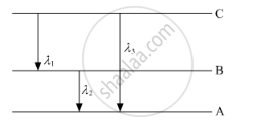
(ii) Find the relation between three wavelengths λ1, λ2 and λ3 from the energy-level diagram shown below.
Calculate the radius of Bohr’s fifth orbit for hydrogen atom
The radius of the innermost electron orbit of a hydrogen atom is 5.3 × 10⁻¹¹ m. What are the radii of the n = 2 and n = 3 orbits?
Write postulates of Bohr’s Theory of hydrogen atom.
If a proton had a radius R and the charge was uniformly distributed, calculate using Bohr theory, the ground state energy of a H-atom when (i) R = 0.1 Å, and (ii) R = 10 Å.
How will the energy of a hydrogen atom change if n increases from 1 to ∞?
Find the angular momentum of an electron revolving in the second orbit in Bohr's hydrogen atom.
What happens to an electron revolving in a circular orbit according to classical electromagnetic theory?
What are the atom's stationary states?
Which expression gives the orbital frequency used to calculate the initial frequency of light emitted under classical electromagnetic theory?
