मराठी

Name the device which converts the change in intensity of illumination to change in electric current flowing through it. Plot I-V - Physics

Advertisements
Advertisements

प्रश्न

Name the device which converts the change in intensity of illumination to change in electric current flowing through it. Plot I-V characteristics of this device for different intensities. State any two applications of this device.

थोडक्यात उत्तर
Advertisements

उत्तर

Photodiodes are used to detect optical signals of different intensities by changing current flowing through them.
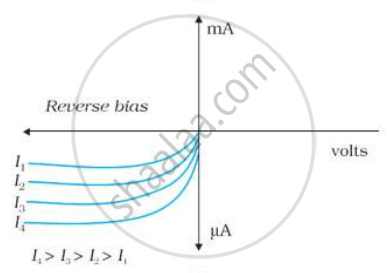
                I-V Characteristics of a photodiode

Applications of photodiodes:

  1. In detection of optical signals.
  2. In demodulation of optical signals.
  3. In light operated switches. 
  4. In speed reading of computer punched cards.
  5. In electronic counters.
shaalaa.com
  या प्रश्नात किंवा उत्तरात काही त्रुटी आहे का?
2021-2022 (March) Term 2 Sample

व्हिडिओ ट्यूटोरियलVIEW ALL [3]

संबंधित प्रश्‍न

Using the necessary circuit diagrams, show how the V-I characteristics of a p-n junction are obtained in

Reverse biasing

How are these characteristics made use of in rectification?


State its any ‘two’ uses of photodiode.


How is a photodiode fabricated?


Briefly explain its working. Draw its V - I characteristics for two different intensities of illumination ?


Draw the circuit diagram of a full wave rectifier using p-n junction diode.

Explain its working and show the output, input waveforms.


Draw the circuit diagram of an illuminated photodiode in reverse bias. How is photodiode used to measure light intensity?


The plate resistance of a triode is 8 kΩ and the transconductance is 2.5 millimho. (a) If the plate voltage is increased by 48 V and the grid voltage is kept constant, what will be the increase in the plate current? (b) With plate voltage kept constant at this increased value, by how much should the grid voltage be decreased in order to bring the plate current back to its initial value?


Explain how a potential barrier is developed in a p-n junction diode.


Explain the three processes involved in the working of a solar cell.


Read the following paragraph and answer the questions.

LED is a heavily doped P-N junction which under forward bias emits spontaneous radiation. When it is forward-biased, due to recombination of holes and electrons at the junction, energy is released in the form of photons. In the case of Si and Ge diode, the energy released in recombination lies in the infrared region. LEDs that can emit red, yellow, orange, green and blue light are commercially available. The semiconductor used for fabrication of visible LEDs must at least have a band gap of 1.8 eV. The compound semiconductor Gallium Arsenide – Phosphide is used for making LEDs of different colours.


LEDs of different kinds

  1. Why are LEDs made of compound semiconductor and not of elemental semiconductors?
  2. What should be the order of bandgap of an LED, if it is required to emit light in the visible range?
  3. A student connects the blue coloured LED as shown in the figure. The LED did not glow when switch S is closed. Explain why?

    OR
    iii. Draw V-I characteristic of a p-n junction diode in
    (i) forward bias and (ii) reverse bias

Share
Notifications

Englishहिंदीमराठी


      Forgot password?
Use app×