Advertisements
Advertisements
Question
Name the device which converts the change in intensity of illumination to change in electric current flowing through it. Plot I-V characteristics of this device for different intensities. State any two applications of this device.
Advertisements
Solution
Photodiodes are used to detect optical signals of different intensities by changing current flowing through them.
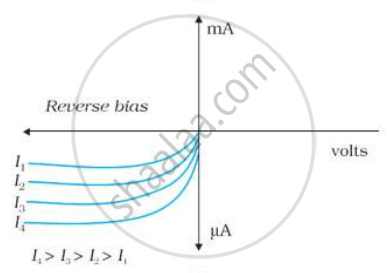
I-V Characteristics of a photodiode
Applications of photodiodes:
- In detection of optical signals.
- In demodulation of optical signals.
- In light operated switches.
- In speed reading of computer punched cards.
- In electronic counters.
APPEARS IN
RELATED QUESTIONS
With the help of a neat circuit diagram, explain the working of a photodiode.
Colour of light emitted by LED depends upon__________________ .
- its forward bias
- its reverse bias
- the band gap of the material of semiconductor
- its size
Explain with the help of a diagram, how depletion region and potential barrier are formed in a junction diode.
A p-n photodiode is fabricated from a semiconductor with band gap of 2.8 eV. Can it detect a wavelength of 6000 nm?
Draw the circuit diagram of a full wave rectifier using p-n junction diode.
Explain its working and show the output, input waveforms.
Describe briefly, with the help of a diagram, the role of the two important processes involved in the formation of a p-n junction.
How does a light emitting diode (LED) work? Give two advantages of LED’s over the conventional incandescent lamps.
With reference to Semiconductor Physics,
Name the process that causes depletion region in a p-n junction.
A p-n photodiode is fabricated from a semiconductor with a band gap of 2.5 eV. lt can detect a signal of wavelength ______.
Why a photo-diode is operated in reverse bias whereas the current in the forward bias is much larger than that in the reverse bias? Explain. Mention its two uses.
