Advertisements
Advertisements
प्रश्न
Describe, with the help of a circuit diagram, the working of a photodiode.
Advertisements
उत्तर
Photo diode is a p-n junction diode made of photosensitive semiconductor in which current carriers are generated by photons through photo excitation, i.e., photo conduction by light. It is operated under reverse bias below the breakdown voltage.
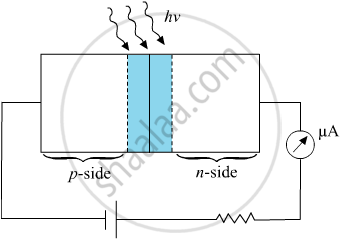
Working of Photo diode
- The diode is fabricated such that the generation of e-h pairs takes place in or near the depletion region of the diode.
When visible light of energy greater than forbidden energy gap ( \[h\nu > E_g\] ) is incident on a reverse bias p-n junction photo diode, additional electron-hole pairs are created in the depletion region ( or near the Junction).
- These charge carriers will be separated by the junction and made to flow across the junction, creating a reverse current across the junction.
- The direction of the electric field is such that electrons reach n-side and holes are
- The value of reverse saturation current increases with the increase in the intensity of incident light as shown here. Hence, thereverse saturation current through the photo diode varies linearly with the light intensity.
- collected on p-side giving rise to an emf.
I – V characteristics of photo diode

APPEARS IN
संबंधित प्रश्न
Explain with the help of a diagram, how depletion region and potential barrier are formed in a junction diode.
A p-n photodiode is fabricated from a semiconductor with band gap of 2.8 eV. Can it detect a wavelength of 6000 nm?
Write briefly the important processes that occur during the formation of p−n junction. With the help of necessary diagrams, explain the term 'barrier potential'.
The plate resistance of a triode is 8 kΩ and the transconductance is 2.5 millimho. (a) If the plate voltage is increased by 48 V and the grid voltage is kept constant, what will be the increase in the plate current? (b) With plate voltage kept constant at this increased value, by how much should the grid voltage be decreased in order to bring the plate current back to its initial value?
What is the magnitude of the potential barrier across a Ge p-n junction?
Name the device which converts the change in intensity of illumination to change in electric current flowing through it. Plot I-V characteristics of this device for different intensities. State any two applications of this device.
Pressure P varies as P = `alpha/beta "exp" (- (alpha x)/"k"_"BT")`, where x denotes the distance, kB is the Boltzmann's constant, T is the absolute temperature and α and β are constant. The dimension of β is ______.
The amplifiers X, Y and Z are connected in series. If the voltage gains of X, Y and Z are 10, 20 and 30, respectively and the input signal is 1 mV peak value, then what is the output signal voltage (peak value)
- if dc supply voltage is 10V?
- if dc supply voltage is 5V?
Why a photo-diode is operated in reverse bias whereas the current in the forward bias is much larger than that in the reverse bias? Explain. Mention its two uses.
How can a photodiode be used to measure light intensity?
