Advertisements
Advertisements
प्रश्न
Find the intensity at a point on a screen in Young's double slit experiment where the interfering waves have a path difference of (i) λ/6, and (ii) λ/2.
Advertisements
उत्तर
Resultant intensity of the interfering waves can be given by
I' = I1 + I2 +2√I1I2 cosδ
where I1 and I2 are the intensities of light emitted by first and second source respectively and δ is the phase difference between two waves emitted by light sources.
In Young's double slit experiment since a single light source is used. Therefore I1 = I2
This implies, I' = 2I + 2Icosδ
(i) If path difference is λ/6
\[\text { Then phase difference }, \delta = ( \frac{2\pi}{\lambda} ) \times \text { path difference } \]
\[ = \frac{2\pi}{\lambda} \times \frac{\lambda}{6} \]
\[ = \frac{\pi}{3}\]
∴ I' = 2I +2I cos(π/3)
= 2I + 2I(1/2)
= 2I + I
= 3I
(ii) If path difference is λ/2
\[\text { Then phase difference }, \delta = ( \frac{2\pi}{\lambda} ) \times \text { path difference } \]
\[ = \frac{2\pi}{\lambda} \times \frac{\lambda}{2} \]
\[ = \pi\]
I' = 2I +2I cos(π)
= 2I + 2I (-1)
= 2I - 2I
= 0
APPEARS IN
संबंधित प्रश्न
A monochromatic light of wavelength 500 nm is incident normally on a single slit of width 0.2 mm to produce a diffraction pattern. Find the angular width of the central maximum obtained on the screen.
Estimate the number of fringes obtained in Young's double slit experiment with fringe width 0.5 mm, which can be accommodated within the region of total angular spread of the central maximum due to single slit.
In Young’s double slit experiment using monochromatic light of wavelength λ, the intensity of light at a point on the screen where path difference is λ, is K units. Find out the intensity of light at a point where path difference is λ/3.
A Young's double slit experiment is performed with white light.
(a) The central fringe will be white.
(b) There will not be a completely dark fringe.
(c) The fringe next to the central will be red.
(d) The fringe next to the central will be violet.
A source emitting light of wavelengths 480 nm and 600 nm is used in a double-slit interference experiment. The separation between the slits is 0.25 mm and the interference is observed on a screen placed at 150 cm from the slits. Find the linear separation between the first maximum (next to the central maximum) corresponding to the two wavelengths.
Consider the arrangement shown in the figure. By some mechanism, the separation between the slits S3 and S4 can be changed. The intensity is measured at the point P, which is at the common perpendicular bisector of S1S2 and S2S4. When \[z = \frac{D\lambda}{2d},\] the intensity measured at P is I. Find the intensity when z is equal to
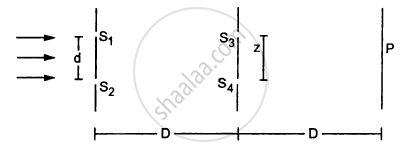
(a) \[\frac{D\lambda}{d}\]
(b) \[\frac{3D\lambda}{2d}\] and
(c) \[\frac{2D\lambda}{d}\]
Two balls are projected at an angle θ and (90° − θ) to the horizontal with the same speed. The ratio of their maximum vertical heights is:
In Young's double slit experiment shown in figure S1 and S2 are coherent sources and S is the screen having a hole at a point 1.0 mm away from the central line. White light (400 to 700 nm) is sent through the slits. Which wavelength passing through the hole has strong intensity?

Interference fringes are observed on a screen by illuminating two thin slits 1 mm apart with a light source (λ = 632.8 nm). The distance between the screen and the slits is 100 cm. If a bright fringe is observed on a screen at distance of 1.27 mm from the central bright fringe, then the path difference between the waves, which are reaching this point from the slits is close to :
What is the consequence of random phase variation for ordinary light sources?
For small angles, what is the approximate path difference at a point a distance \(x\) from the central bright fringe?
