हिंदी

Describe, with the Help of a Circuit Diagram, the Working of a Photodiode. - Physics

Advertisements
Advertisements

प्रश्न

Describe, with the help of a circuit diagram, the working of a photodiode.

Advertisements

उत्तर

Photo diode is a p-n junction diode made of photosensitive semiconductor in which current carriers are generated by photons through photo excitation, i.e., photo conduction by light. It is operated under reverse bias below the breakdown voltage. 
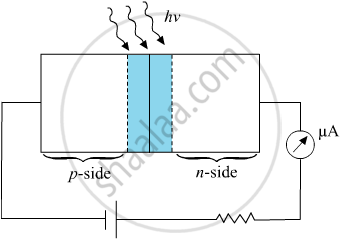

Working of Photo diode

  • The diode is fabricated such that the generation of e-h pairs takes place in or near the depletion region of the diode.

When visible light of energy greater than forbidden energy gap ( \[h\nu > E_g\] ) is incident on a reverse bias p-n junction photo diode, additional electron-hole pairs are created in the depletion region ( or near the Junction).

  • These charge carriers will be separated by the junction and made to flow across the junction, creating a reverse current across the junction.
  • The direction of the electric field is such that electrons reach n-side and holes are
  • The value of reverse saturation current increases with the increase in the intensity of incident light as shown here. Hence, thereverse saturation current through the photo diode varies linearly with the light intensity.
  • collected on p-side giving rise to an emf.

I – V characteristics of photo diode

shaalaa.com
  क्या इस प्रश्न या उत्तर में कोई त्रुटि है?
2016-2017 (March) Foreign Set 3

वीडियो ट्यूटोरियलVIEW ALL [3]

संबंधित प्रश्न

If a small voltage is applied to a p-n junction diode, how will the barrier potential be affected when it is(ii) reveres biased?


Carbon, silicon and germanium have four valence electrons each. These are characterised by valence and conduction bands separated by energy band gap respectively equal to (Eg)C, (Eg)Si and (Eg)Ge. Which of the following statements is true?


A p-n photodiode is fabricated from a semiconductor with band gap of 2.8 eV. Can it detect a wavelength of 6000 nm?


Draw V − I characteristics of a p-n junction diode. Answer the following questions, giving reasons:

(i) Why is the current under reverse bias almost independent of the applied potential up to a critical voltage?

(ii) Why does the reverse current show a sudden increase at the critical voltage?

Name any semiconductor device which operates under the reverse bias in the breakdown region.


Draw the circuit diagram of an illuminated photodiode in reverse bias. How is photodiode used to measure light intensity?


The wavelength and intensity of light emitted by a LED depend upon ______.


Consider the following statements (A) and (B) and identify the correct answer.

  1. A Zener diode is connected in reverse bias when used as a voltage regulator.
  2. The potential barrier of the p-n junction lies between 0.1 V to 0.3 V.

Read the following paragraph and answer the questions.

LED is a heavily doped P-N junction which under forward bias emits spontaneous radiation. When it is forward-biased, due to recombination of holes and electrons at the junction, energy is released in the form of photons. In the case of Si and Ge diode, the energy released in recombination lies in the infrared region. LEDs that can emit red, yellow, orange, green and blue light are commercially available. The semiconductor used for fabrication of visible LEDs must at least have a band gap of 1.8 eV. The compound semiconductor Gallium Arsenide – Phosphide is used for making LEDs of different colours.


LEDs of different kinds

  1. Why are LEDs made of compound semiconductor and not of elemental semiconductors?
  2. What should be the order of bandgap of an LED, if it is required to emit light in the visible range?
  3. A student connects the blue coloured LED as shown in the figure. The LED did not glow when switch S is closed. Explain why?

    OR
    iii. Draw V-I characteristic of a p-n junction diode in
    (i) forward bias and (ii) reverse bias

Draw solar cells of I-V characteristics.


How can a photodiode be used to measure light intensity?


Share
Notifications

Englishहिंदीमराठी


      Forgot password?
Use app×