Advertisements
Advertisements
प्रश्न
The simple Bohr model cannot be directly applied to calculate the energy levels of an atom with many electrons. This is because ______.
विकल्प
of the electrons not being subject to a central force.
of the electrons colliding with each other.
of screening effects.
the force between the nucleus and an electron will no longer be given by Coulomb’s law.
Advertisements
उत्तर
The simple Bohr model cannot be directly applied to calculate the energy levels of an atom with many electrons. This is because of the electrons not being subject to a central force.
Explanation:
The simple Bohr model cannot be directly applied to calculate the energy levels of an atom with many electrons because when we derive the formula for radius/energy levels etc, we make the assumption that centripetal force is provided only by the electrostatic force of attraction by the nucleus. Hence, this will only work for single electron atoms. In multi-electron atoms, there will also be repulsion due to other electrons. The simple Bohr model cannot be directly applied to calculate the energy levels of an atom with many electrons.
APPEARS IN
संबंधित प्रश्न
(i) State Bohr's quantization condition for defining stationary orbits. How does the de Broglie hypothesis explain the stationary orbits?
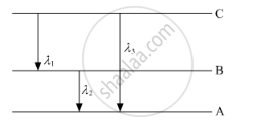
(ii) Find the relation between three wavelengths λ1, λ2 and λ3 from the energy-level diagram shown below.
The longest wavelength doublet absorption transition is observed at 589 and 589.6 nm. Calculate the frequency of each transition and energy difference between two excited states.
On the basis of Bohr's theory, derive an expression for the radius of the nth orbit of an electron of the hydrogen atom.
In a laser tube, all the photons
According to Maxwell's theory of electrodynamics, an electron going in a circle should emit radiation of frequency equal to its frequency of revolution. What should be the wavelength of the radiation emitted by a hydrogen atom in ground state if this rule is followed?
A neutron moving with a speed υ strikes a hydrogen atom in ground state moving towards it with the same speed. Find the minimum speed of the neutron for which inelastic (completely or partially) collision may take place. The mass of neutron = mass of hydrogen = 1.67 × 10⁻²⁷ kg.v
Suppose in an imaginary world the angular momentum is quantized to be even integral multiples of h/2π. What is the longest possible wavelength emitted by hydrogen atoms in visible range in such a world according to Bohr's model?
Using Bohr's postulates derive the expression for the radius of nth orbit of the electron.
Hydrogen atom has only one electron, so mutual repulsion between electrons is absent. However, in multielectron atoms mutual repulsion between the electrons is significant. How does this affect the energy of an electron in the orbitals of the same principal quantum number in multielectron atoms?
Consider two different hydrogen atoms. The electron in each atom is in an excited state. Is it possible for the electrons to have different energies but same orbital angular momentum according to the Bohr model? Justify your answer.
In form of Rydberg's constant R, the wave no of this first Ballmer line is
The number of times larger the spacing between the energy levels with n = 3 and n = 8 spacing between the energy level with n = 8 and n = 9 for the hydrogen atom is ______.
Find the ratio of energies of photons produced due to transition of an election of hydrogen atom from its (i) second permitted energy level to the first level. and (ii) the highest permitted energy level to the first permitted level.
The first ionization energy of H is 21.79 × 10⁻¹⁹ J. The second ionization energy of He atom is ______ × 10-19J.
In Bohr's theory of hydrogen atom, the electron jumps from higher orbit n to lower orbit p. The wavelength will be minimum for the transition ______.
According to Bohr's theory, the radius of the nth Bohr orbit of a hydrogen like atom of atomic number Z is proportional to ______.
What is the velocity of an electron in the 3rd orbit of hydrogen atom if its velocity in the 1st orbit is v0?
What happens to an electron revolving in a circular orbit according to classical electromagnetic theory?
Which conversion relates an electron volt to joules?
