Advertisements
Advertisements
प्रश्न
A set of atoms in an excited state decays ______.
विकल्प
in general to any of the states with lower energy.
into a lower state only when excited by an external electric field.
all together simultaneously into a lower state.
to emit photons only when they collide.
Advertisements
उत्तर
A set of atoms in an excited state decays in general to any of the states with lower energy.
Explanation:
When a hydrogen atom is excited, it returns to its: normal unexcited (or ground’ state) state by emitting the energy it had absorbed carli¢r, This energy is given out by the atom in the form of radiations of different wavelengths as the electron jumps down from a higher to a lower orbit. The transition from different orbits causes different wavelengths, these constitute spectral. series which ‘are characteristic of the atom emitting them. When observed through a spectroscope, these radiations are imaged as sharp and straight vertical lines of a single colour.
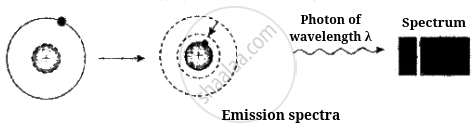
The spectral lines arising from the transition of an electron form a spectra series.
1. Mainly there are five series and each series is named after its discoverer as Lyman series, Balmer series, Paschen series, Bracket series and Pfund series.
2. According to Bohr's theory, the wavelength of the radiations emitted from hydrogen atom is given by
`1/λ = R[1/n_1^2 - 1/n_2^2]`
⇒ λ = `(n_1^2n_2^2)/((n_2^2 - n_1^2)R) = n_1^2/((1 - n_1^2/n_2^2)R)`
where n2 = outer orbit (electron jumps from this orbit), , = inner orbit (electron fills in this orbit)
A set of atoms in an excited state decays in general to any of the states with lower energy.
APPEARS IN
संबंधित प्रश्न
Find the frequency of revolution of an electron in Bohr’s 2nd orbit; if the radius and speed of electron in that orbit is 2.14 × 10⁻¹⁰ m and 1.09 × 10⁶ m/s respectively. [π= 3.142]
The energy associated with the first orbit in the hydrogen atom is - 2.18 × 10⁻¹⁸ J atom-1. What is the energy associated with the fifth orbit?
What is the energy in joules, required to shift the electron of the hydrogen atom from the first Bohr orbit to the fifth Bohr orbit and what is the wavelength of the light emitted when the electron returns to the ground state? The ground state electron energy is –2.18 × 10⁻¹¹ ergs.
State Bohr postulate of hydrogen atom that gives the relationship for the frequency of emitted photon in a transition.
In a laser tube, all the photons
According to Bohr, 'Angular momentum of an orbiting electron is quantized'. What is meant by this statement?
Which of these statements correctly describe the atomic model according to classical electromagnetic theory?
According to the Bohr theory of H-atom, the speed of the electron, its energy and the radius of its orbit varies with the principal quantum number n, respectively, as:
An ionised H-molecule consists of an electron and two protons. The protons are separated by a small distance of the order of angstrom. In the ground state ______.
- the electron would not move in circular orbits.
- the energy would be (2)4 times that of a H-atom.
- the electrons, orbit would go around the protons.
- the molecule will soon decay in a proton and a H-atom.
Using Bohr model, calculate the electric current created by the electron when the H-atom is in the ground state.
The first ionization energy of H is 21.79 × 10⁻¹⁹ J. The second ionization energy of He atom is ______ × 10-19J.
A hydrogen atom in is ground state absorbs 10.2 eV of energy. The angular momentum of electron of the hydrogen atom will increase by the value of ______.
(Given, Planck's constant = 6.6 × 10⁻³⁴ Js)
Oxygen is 16 times heavier than hydrogen. Equal volumes of hydrogen and oxygen are mixed. The ratio of speed of sound in the mixture to that in hydrogen is ______.
An electron in a hydrogen atom has an energy of -3.4 eV. The difference between its kinetic and potential energy is ______.
On the basis of Bohr's theory, derive an expression for the radius of the nth orbit of an electron of hydrogen atom.
State the Bohr's postulate of angular momentum of an electron.
Which from following is CORREСТ relationship between wavelength and momentum of electron?
Which law of force governs the nucleus-electron system?
What does classical electromagnetic theory predict for an accelerating charged particle?
Which expression gives the quantised angular momentum of the orbiting electron?
