Advertisements
Advertisements
प्रश्न
State Bohr postulate of hydrogen atom that gives the relationship for the frequency of emitted photon in a transition.
Advertisements
उत्तर
According to Bohr's postulate: electron might make a transition from one of its specified non-radiating orbits to another of lower energy. When it does so, a photon is emitted having energy equal to the energy difference between the initial and final state.
hν = Ei − Ef
APPEARS IN
संबंधित प्रश्न
(i) State Bohr's quantization condition for defining stationary orbits. How does the de Broglie hypothesis explain the stationary orbits?
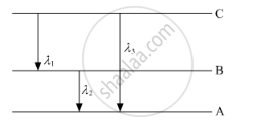
(ii) Find the relation between three wavelengths λ1, λ2 and λ3 from the energy-level diagram shown below.
Show that the circumference of the Bohr orbit for the hydrogen atom is an integral multiple of the de Broglie wavelength associated with the electron revolving around the orbit.
The electron in hydrogen atom is initially in the third excited state. What is the maximum number of spectral lines which can be emitted when it finally moves to the ground state?
Write the expression for Bohr’s radius in hydrogen atom ?
Consider a neutron and an electron bound to each other due to gravitational force. Assuming Bohr's quantization rule for angular momentum to be valid in this case, derive an expression for the energy of the neutron-electron system.
Draw energy level diagram for a hydrogen atom, showing the first four energy levels corresponding to n=1, 2, 3 and 4. Show transitions responsible for:
(i) Absorption spectrum of Lyman series.
(ii) The emission spectrum of the Balmer series.
For an electron in the second orbit of hydrogen, what is the moment of momentum as per the Bohr's model?
In hydrogen atom, transition from the state n = 6 to n = 1 results in ultraviolet radiation. Infrared radiation will be obtained in the transition ______.
Oxygen is 16 times heavier than hydrogen. Equal volumes of hydrogen and oxygen are mixed. The ratio of speed of sound in the mixture to that in hydrogen is ______.
Which from following is CORREСТ relationship between wavelength and momentum of electron?
