Advertisements
Advertisements
प्रश्न
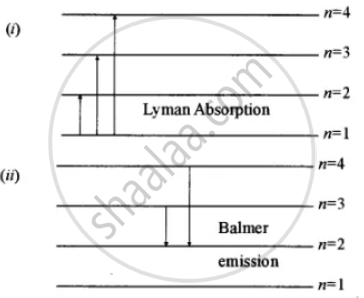
Draw energy level diagram for a hydrogen atom, showing the first four energy levels corresponding to n=1, 2, 3 and 4. Show transitions responsible for:
(i) Absorption spectrum of Lyman series.
(ii) The emission spectrum of the Balmer series.
Advertisements
उत्तर
APPEARS IN
संबंधित प्रश्न
Using Bohr's postulates, derive the expression for the orbital period of the electron moving in the nth orbit of hydrogen atom ?
According to Maxwell's theory of electrodynamics, an electron going in a circle should emit radiation of frequency equal to its frequency of revolution. What should be the wavelength of the radiation emitted by a hydrogen atom in ground state if this rule is followed?
The light emitted in the transition n = 3 to n = 2 in hydrogen is called Hα light. Find the maximum work function a metal can have so that Hα light can emit photoelectrons from it.
Hydrogen atom has only one electron, so mutual repulsion between electrons is absent. However, in multielectron atoms mutual repulsion between the electrons is significant. How does this affect the energy of an electron in the orbitals of the same principal quantum number in multielectron atoms?
The simple Bohr model cannot be directly applied to calculate the energy levels of an atom with many electrons. This is because ______.
The energy of an electron in the first Bohr orbit of the H-atom is −13.6 eV. The energy value of an electron in the excited state of Li2+ is ______.
The total energy of an electron in the nth orbit of the hydrogen atom is proportional to ______.
The energy of an electron in the nth orbit of the hydrogen atom is En = -13.6/n2eV. The negative sign of energy indicates that ______.
Calculate the energy associated with third orbit of He+.
Which expression gives the orbital frequency used to calculate the initial frequency of light emitted under classical electromagnetic theory?
