Advertisements
Advertisements
Question
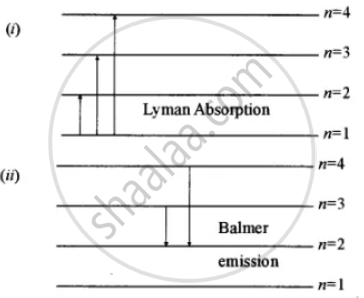
Draw energy level diagram for a hydrogen atom, showing the first four energy levels corresponding to n=1, 2, 3 and 4. Show transitions responsible for:
(i) Absorption spectrum of Lyman series.
(ii) The emission spectrum of the Balmer series.
Advertisements
Solution
APPEARS IN
RELATED QUESTIONS
What is the maximum number of emission lines when the excited electron of an H atom in n = 6 drops to the ground state?
- Using the Bohr’s model, calculate the speed of the electron in a hydrogen atom in the n = 1, 2 and 3 levels.
- Calculate the orbital period in each of these levels.
Balmer series was observed and analysed before the other series. Can you suggest a reason for such an order?
Which of the following parameters are the same for all hydrogen-like atoms and ions in their ground states?
What is the energy in joules released when an electron moves from n = 2 to n = 1 level in a hydrogen atom?
The binding energy of a H-atom, considering an electron moving around a fixed nuclei (proton), is B = `- (Me^4)/(8n^2ε_0^2h^2)`. (m = electron mass). If one decides to work in a frame of reference where the electron is at rest, the proton would be moving around it. By similar arguments, the binding energy would be
B = `- (Me^4)/(8n^2ε_0^2h^2)` (M = proton mass)
This last expression is not correct because ______.
When an electron falls from a higher energy to a lower energy level, the difference in the energies appears in the form of electromagnetic radiation. Why cannot it be emitted as other forms of energy?
How will the energy of a hydrogen atom change if n increases from 1 to ∞?
Find the ratio of energies of photons produced due to transition of an election of hydrogen atom from its (i) second permitted energy level to the first level. and (ii) the highest permitted energy level to the first permitted level.
On the basis of Bohr's theory, derive an expression for the radius of the nth orbit of an electron of hydrogen atom.
