Advertisements
Advertisements
Question
A set of atoms in an excited state decays ______.
Options
in general to any of the states with lower energy.
into a lower state only when excited by an external electric field.
all together simultaneously into a lower state.
to emit photons only when they collide.
Advertisements
Solution
A set of atoms in an excited state decays in general to any of the states with lower energy.
Explanation:
When a hydrogen atom is excited, it returns to its: normal unexcited (or ground’ state) state by emitting the energy it had absorbed carli¢r, This energy is given out by the atom in the form of radiations of different wavelengths as the electron jumps down from a higher to a lower orbit. The transition from different orbits causes different wavelengths, these constitute spectral. series which ‘are characteristic of the atom emitting them. When observed through a spectroscope, these radiations are imaged as sharp and straight vertical lines of a single colour.
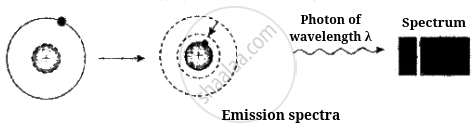
The spectral lines arising from the transition of an electron form a spectra series.
1. Mainly there are five series and each series is named after its discoverer as Lyman series, Balmer series, Paschen series, Bracket series and Pfund series.
2. According to Bohr's theory, the wavelength of the radiations emitted from hydrogen atom is given by
`1/λ = R[1/n_1^2 - 1/n_2^2]`
⇒ λ = `(n_1^2n_2^2)/((n_2^2 - n_1^2)R) = n_1^2/((1 - n_1^2/n_2^2)R)`
where n2 = outer orbit (electron jumps from this orbit), , = inner orbit (electron fills in this orbit)
A set of atoms in an excited state decays in general to any of the states with lower energy.
APPEARS IN
RELATED QUESTIONS
Using Bohr's postulates of the atomic model, derive the expression for radius of nth electron orbit. Hence obtain the expression for Bohr's radius.
The longest wavelength doublet absorption transition is observed at 589 and 589.6 nm. Calculate the frequency of each transition and energy difference between two excited states.
If the velocity of the electron in Bohr’s first orbit is 2.19 × 10⁶ ms-1, calculate the de Broglie wavelength associated with it.
In accordance with the Bohr’s model, find the quantum number that characterises the earth’s revolution around the sun in an orbit of radius 1.5 × 10¹¹ m with orbital speed 3 × 10⁴ m/s. (Mass of earth = 6.0 × 1024 kg)
The numerical value of ionization energy in eV equals the ionization potential in volts. Does the equality hold if these quantities are measured in some other units?
According to Maxwell's theory of electrodynamics, an electron going in a circle should emit radiation of frequency equal to its frequency of revolution. What should be the wavelength of the radiation emitted by a hydrogen atom in ground state if this rule is followed?
When a photon is emitted by a hydrogen atom, the photon carries a momentum with it. (a) Calculate the momentum carries by the photon when a hydrogen atom emits light of wavelength 656.3 nm. (b) With what speed does the atom recoil during this transition? Take the mass of the hydrogen atom = 1.67 × 10⁻²⁷ kg. (c) Find the kinetic energy of recoil of the atom.
Radiation from hydrogen discharge tube falls on a cesium plate. Find the maximum possible kinetic energy of the photoelectrons. Work function of cesium is 1.9 eV.
Suppose in an imaginary world the angular momentum is quantized to be even integral multiples of h/2π. What is the longest possible wavelength emitted by hydrogen atoms in visible range in such a world according to Bohr's model?
When the electron orbiting in hydrogen atom in its ground state moves to the third excited state, show how the de Broglie wavelength associated with it would be affected.
Mention demerits of Bohr’s Atomic model.
Which of the following is/are CORRECT according to Bohr's atomic theory?
(I) Energy is emitted when electron moves from a higher stationary state to a lower one.
(II) Orbits are arranged concentrically around the nucleus in an increasing order of energy.
(III) The energy of an electron in the orbit changes with time.
When an electric discharge is passed through hydrogen gas, the hydrogen molecules dissociate to produce excited hydrogen atoms. These excited atoms emit electromagnetic radiation of discrete frequencies which can be given by the general formula
`bar(v) = 109677 1/n_1^2 - 1/n_f^2`
What points of Bohr’s model of an atom can be used to arrive at this formula? Based on these points derive the above formula giving description of each step and each term.
The binding energy of a H-atom, considering an electron moving around a fixed nuclei (proton), is B = `- (Me^4)/(8n^2ε_0^2h^2)`. (m = electron mass). If one decides to work in a frame of reference where the electron is at rest, the proton would be moving around it. By similar arguments, the binding energy would be
B = `- (Me^4)/(8n^2ε_0^2h^2)` (M = proton mass)
This last expression is not correct because ______.
Using Bohr model, calculate the electric current created by the electron when the H-atom is in the ground state.
According to Bohr atom model, in which of the following transitions will the frequency be maximum?
The total energy of an electron in the nth orbit of the hydrogen atom is proportional to ______.
What happens to an electron revolving in a circular orbit according to classical electromagnetic theory?
Which expression gives the quantised angular momentum of the orbiting electron?
