Advertisements
Advertisements
Question
Evaluate Rydberg constant by putting the values of the fundamental constants in its expression.
Advertisements
Solution
Expression of Rydberg constant (R) is given by
`R = (me^4)/(8h^2c ∈_0^2)`
Mass of electron, me = `9.31 xx 10^21 xx kg `
Charge, e = 1.6 × 10⁻¹⁹ C
]Planck's constant, h = 6.63 × 10⁻³⁴ J-s,
Speed of light, c = 3 × 10⁸ m/s,
Permittivity of vacuum, ∈0 = 8.85 × 10⁻¹² C2N1m
On substituting the values in the expression, we get
`R = ((9.31xx10^-31)xx(1.6xx10^-19)^4)/(8 xx(6.63xx10^-14)^2 xx (3xx10^8)xx(8.85xx10^-12)^2`
`rArr R = 1.097 xx 10^7 m^-1`
APPEARS IN
RELATED QUESTIONS
(i) State Bohr's quantization condition for defining stationary orbits. How does the de Broglie hypothesis explain the stationary orbits?
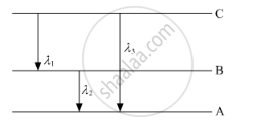
(ii) Find the relation between three wavelengths λ1, λ2 and λ3 from the energy-level diagram shown below.
Using Bohr's postulates, derive the expression for the orbital period of the electron moving in the nth orbit of hydrogen atom ?
The Bohr radius is given by `a_0 = (∈_0h^2)/{pime^2}`. Verify that the RHS has dimensions of length.
When a photon is emitted by a hydrogen atom, the photon carries a momentum with it. (a) Calculate the momentum carries by the photon when a hydrogen atom emits light of wavelength 656.3 nm. (b) With what speed does the atom recoil during this transition? Take the mass of the hydrogen atom = 1.67 × 10⁻²⁷ kg. (c) Find the kinetic energy of recoil of the atom.
According to Bohr, 'Angular momentum of an orbiting electron is quantized'. What is meant by this statement?
Calculate the de-Broglie wavelength associated with the electron revolving in the first excited state of the hydrogen atom. The ground state energy of the hydrogen atom is −13.6 eV.
Write postulates of Bohr’s Theory of hydrogen atom.
The dissociation constant of a weak base (BOH) is 1.8 × 10⁻⁵. Its degree of dissociation in 0.001 M solution is ____________.
When an electric discharge is passed through hydrogen gas, the hydrogen molecules dissociate to produce excited hydrogen atoms. These excited atoms emit electromagnetic radiation of discrete frequencies which can be given by the general formula
`bar(v) = 109677 1/n_1^2 - 1/n_f^2`
What points of Bohr’s model of an atom can be used to arrive at this formula? Based on these points derive the above formula giving description of each step and each term.
Why was a change in the Bohr Model of atom required? Due to which important development (s), concept of movement of an electron in an orbit was replaced by, the concept of probability of finding electron in an orbital? What is the name given to the changed model of atom?
The inverse square law in electrostatics is |F| = `e^2/((4πε_0).r^2)` for the force between an electron and a proton. The `(1/r)` dependence of |F| can be understood in quantum theory as being due to the fact that the ‘particle’ of light (photon) is massless. If photons had a mass mp, force would be modified to |F| = `e^2/((4πε_0)r^2) [1/r^2 + λ/r]`, exp (– λr) where λ = mpc/h and h = `h/(2π)`. Estimate the change in the ground state energy of a H-atom if mp were 10-6 times the mass of an electron.
The energy required to remove the electron from a singly ionized Helium atom is 2.2 times the energy required to remove an electron from Helium atom. The total energy required to ionize the Helium atom completely is ______.
The first ionization energy of H is 21.79 × 10⁻¹⁹ J. The second ionization energy of He atom is ______ × 10-19J.
In Bohr's theory of hydrogen atom, the electron jumps from higher orbit n to lower orbit p. The wavelength will be minimum for the transition ______.
Oxygen is 16 times heavier than hydrogen. Equal volumes of hydrogen and oxygen are mixed. The ratio of speed of sound in the mixture to that in hydrogen is ______.
The wavelength of the second line of the Balmer series in the hydrogen spectrum is 4861 Å. Calculate the wavelength of the first line of the same series.
State the Bohr's postulate of angular momentum of an electron.
What is the velocity of an electron in the 3rd orbit of hydrogen atom if its velocity in the 1st orbit is v0?
Who explained the hydrogen atom's spectrum using quantum ideas?
What happens to an electron revolving in a circular orbit according to classical electromagnetic theory?
