Advertisements
Advertisements
Question
Hydrogen atom has only one electron, so mutual repulsion between electrons is absent. However, in multielectron atoms mutual repulsion between the electrons is significant. How does this affect the energy of an electron in the orbitals of the same principal quantum number in multielectron atoms?
Advertisements
Solution
The energy of electrons is determined by the value of n in the hydrogen atom and by `n + l` in the multielectron atom. Thus for a given principal quantum number the electrons of different orbitals would have different energy.
APPEARS IN
RELATED QUESTIONS
An electron is orbiting in 5th Bohr orbit. Calculate ionisation energy for this atom, if the ground state energy is -13.6 eV.
(i) State Bohr's quantization condition for defining stationary orbits. How does the de Broglie hypothesis explain the stationary orbits?
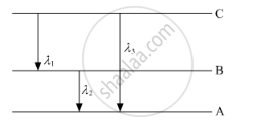
(ii) Find the relation between three wavelengths λ1, λ2 and λ3 from the energy-level diagram shown below.
Lifetimes of the molecules in the excited states are often measured by using pulsed radiation source of duration nearly in the nanosecond range. If the radiation source has a duration of 2 ns and the number of photons emitted during the pulse source is 2.5 × 10¹⁵, calculate the energy of the source.
The radius of the innermost electron orbit of a hydrogen atom is 5.3 × 10⁻¹¹ m. What are the radii of the n = 2 and n = 3 orbits?
State Bohr postulate of hydrogen atom that gives the relationship for the frequency of emitted photon in a transition.
The electron in hydrogen atom is initially in the third excited state. What is the maximum number of spectral lines which can be emitted when it finally moves to the ground state?
A neutron having kinetic energy 12.5 eV collides with a hydrogen atom at rest. Nelgect the difference in mass between the neutron and the hydrogen atom and assume that the neutron does not leave its line of motion. Find the possible kinetic energies of the neutron after the event.
Obtain Bohr’s quantisation condition for angular momentum of electron orbiting in nth orbit in hydrogen atom on the basis of the wave picture of an electron using de Broglie hypothesis.
What is the energy in joules released when an electron moves from n = 2 to n = 1 level in a hydrogen atom?
For an electron in the second orbit of hydrogen, what is the moment of momentum as per the Bohr's model?
Which of these statements correctly describe the atomic model according to classical electromagnetic theory?
According to the Bohr theory of H-atom, the speed of the electron, its energy and the radius of its orbit varies with the principal quantum number n, respectively, as:
For the ground state, the electron in the H-atom has an angular momentum = h, according to the simple Bohr model. Angular momentum is a vector and hence there will be infinitely many orbits with the vector pointing in all possible directions. In actuality, this is not true ______.
The ground state energy of hydrogen atoms is -13.6 eV. The photon emitted during the transition of electron from n = 3 to n = 1 unknown work function. The photoelectrons are emitted from the material with a maximum kinetic energy of 9 eV. Calculate the threshold wavelength of the material used.
The total energy of an electron in the nth orbit of the hydrogen atom is proportional to ______.
An electron in a hydrogen atom has an energy of -3.4 eV. The difference between its kinetic and potential energy is ______.
The wavelength of the second line of the Balmer series in the hydrogen spectrum is 4861 Å. Calculate the wavelength of the first line of the same series.
For the reaction \[\ce{2NO2 (g) ⇌ N2O4(g)}\], when ΔS = −176.0 JK−1 and ΔH = −57.8 kj mol−1, the magnitude of ΔG at 298 K for the reaction is ______ kJ mol−1. (Nearest integer)
The radius of hydrogen atom in the ground state is 0.53 Å. The radius of Li2+ ion (atomic number = 3) in a similar state is ______.
