Advertisements
Advertisements
प्रश्न
A set of atoms in an excited state decays ______.
पर्याय
in general to any of the states with lower energy.
into a lower state only when excited by an external electric field.
all together simultaneously into a lower state.
to emit photons only when they collide.
Advertisements
उत्तर
A set of atoms in an excited state decays in general to any of the states with lower energy.
Explanation:
When a hydrogen atom is excited, it returns to its: normal unexcited (or ground’ state) state by emitting the energy it had absorbed carli¢r, This energy is given out by the atom in the form of radiations of different wavelengths as the electron jumps down from a higher to a lower orbit. The transition from different orbits causes different wavelengths, these constitute spectral. series which ‘are characteristic of the atom emitting them. When observed through a spectroscope, these radiations are imaged as sharp and straight vertical lines of a single colour.
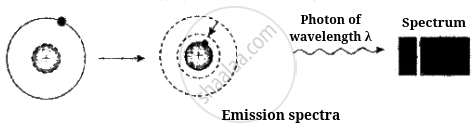
The spectral lines arising from the transition of an electron form a spectra series.
1. Mainly there are five series and each series is named after its discoverer as Lyman series, Balmer series, Paschen series, Bracket series and Pfund series.
2. According to Bohr's theory, the wavelength of the radiations emitted from hydrogen atom is given by
`1/λ = R[1/n_1^2 - 1/n_2^2]`
⇒ λ = `(n_1^2n_2^2)/((n_2^2 - n_1^2)R) = n_1^2/((1 - n_1^2/n_2^2)R)`
where n2 = outer orbit (electron jumps from this orbit), , = inner orbit (electron fills in this orbit)
A set of atoms in an excited state decays in general to any of the states with lower energy.
APPEARS IN
संबंधित प्रश्न
An electron is orbiting in 5th Bohr orbit. Calculate ionisation energy for this atom, if the ground state energy is -13.6 eV.
Draw a neat, labelled energy level diagram for H atom showing the transitions. Explain the series of spectral lines for H atom, whose fixed inner orbit numbers are 3 and 4 respectively.
How many electrons in an atom may have the following quantum numbers?
n = 3, l = 0
The radius of the innermost electron orbit of a hydrogen atom is 5.3 × 10⁻¹¹ m. What are the radii of the n = 2 and n = 3 orbits?
On the basis of Bohr's theory, derive an expression for the radius of the nth orbit of an electron of the hydrogen atom.
Using Bohr’s postulates, obtain the expressions for (i) kinetic energy and (ii) potential energy of the electron in stationary state of hydrogen atom.
Draw the energy level diagram showing how the transitions between energy levels result in the appearance of Lymann Series.
The light emitted in the transition n = 3 to n = 2 in hydrogen is called Hα light. Find the maximum work function a metal can have so that Hα light can emit photoelectrons from it.
According to Bohr, 'Angular momentum of an orbiting electron is quantized'. What is meant by this statement?
What is the energy in joules released when an electron moves from n = 2 to n = 1 level in a hydrogen atom?
A particle has a mass of 0.002 kg and uncertainty in its velocity is 9.2 × 10⁻⁶ m/s, then uncertainty in position is ≥ ____________.
(h = 6.6 × 10⁻³⁴ J s)
Why was a change in the Bohr Model of atom required? Due to which important development (s), concept of movement of an electron in an orbit was replaced by, the concept of probability of finding electron in an orbital? What is the name given to the changed model of atom?
Derive an expression for the frequency of radiation emitted when a hydrogen atom de-excites from level n to level (n – 1). Also show that for large values of n, this frequency equals to classical frequency of revolution of an electron.
How will the energy of a hydrogen atom change if n increases from 1 to ∞?
Orbits of a particle moving in a circle are such that the perimeter of the orbit equals an integer number of de-Broglie wavelengths of the particle. For a charged particle moving in a plane perpendicular to a magnetic field, the radius of the nth orbital will therefore be proportional to:
If 13.6 eV energy is required to ionize the hydrogen atom, then the energy required to remove an electron from n = 2 is ______.
The energy of an electron in the first Bohr orbit of the H-atom is −13.6 eV. The energy value of an electron in the excited state of Li2+ is ______.
A hydrogen atom in is ground state absorbs 10.2 eV of energy. The angular momentum of electron of the hydrogen atom will increase by the value of ______.
(Given, Planck's constant = 6.6 × 10⁻³⁴ Js)
Write the ionisation energy value for the hydrogen atom.
Calculate the radius of the second orbit of He+.
