Advertisements
Advertisements
प्रश्न
According to Bohr, 'Angular momentum of an orbiting electron is quantized'. What is meant by this statement?
Advertisements
उत्तर
This means that electron revolves around the nucleus in fixed i.e., quantized orbits and do not radiate energy i.e., angular momentum in these orbits is an integral multiple of `h/(2pi)`, where h is Planck's constant.
APPEARS IN
संबंधित प्रश्न
(i) State Bohr's quantization condition for defining stationary orbits. How does the de Broglie hypothesis explain the stationary orbits?
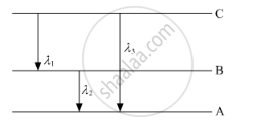
(ii) Find the relation between three wavelengths λ1, λ2 and λ3 from the energy-level diagram shown below.
The numerical value of ionization energy in eV equals the ionization potential in volts. Does the equality hold if these quantities are measured in some other units?
Evaluate Rydberg constant by putting the values of the fundamental constants in its expression.
According to Bohr’s theory, the angular momentum of an electron in 5th orbit is ______.
On the basis of Bohr's model, the approximate radius of Li++ ion in its ground state ifthe Bohr radius is a0 = 53 pm :
The energy of an electron in hth orbit of hydrogen atom is –13.6/n2ev energy required to excite the electron from the first orbit to the third orbit is
Using Bohr’s Theory of hydrogen atom, obtain an expression for the velocity of an electron in the nth orbit of an atom.
State the Bohr's postulate of angular momentum of an electron.
Which expression gives the quantised angular momentum of the orbiting electron?
What happens when an electron makes the transition described by Bohr’s third postulate?
