Advertisements
Advertisements
प्रश्न
In which of the following systems will the wavelength corresponding to n = 2 to n = 1 be minimum?
विकल्प
Hydrogen atom
Deuterium atom
Singly ionized helium
Doubly ionized lithium
Advertisements
उत्तर
Doubly ionized lithium
The wavelength corresponding the transition from n2 to n1 is given by
`1/lamda =RZ^2 (1/n_1^2 - 1/n_2^2)`]
Here,
R = Rydberg constant
Z = Atomic number of the ion
From the given formula, it can be observed that the wavelength is inversely proportional to the square of the atomic number.
Therefore, the wavelength corresponding to n = 2 to n = 1 will be minimum in doubly ionized lithium ion because for lithium, Z = 3.
APPEARS IN
संबंधित प्रश्न
An electron is orbiting in 5th Bohr orbit. Calculate ionisation energy for this atom, if the ground state energy is -13.6 eV.
(i) State Bohr's quantization condition for defining stationary orbits. How does the de Broglie hypothesis explain the stationary orbits?
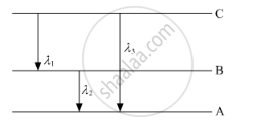
(ii) Find the relation between three wavelengths λ1, λ2 and λ3 from the energy-level diagram shown below.
What is the energy in joules, required to shift the electron of the hydrogen atom from the first Bohr orbit to the fifth Bohr orbit and what is the wavelength of the light emitted when the electron returns to the ground state? The ground state electron energy is –2.18 × 10⁻¹¹ ergs.
The radius of the innermost electron orbit of a hydrogen atom is 5.3 × 10⁻¹¹ m. What are the radii of the n = 2 and n = 3 orbits?
Using Bohr’s postulates, derive the expression for the frequency of radiation emitted when electron in hydrogen atom undergoes transition from higher energy state (quantum number ni) to the lower state, (nf).
When electron in hydrogen atom jumps from energy state ni = 4 to nf = 3, 2, 1, identify the spectral series to which the emission lines belong.
The difference in the frequencies of series limit of Lyman series and Balmer series is equal to the frequency of the first line of the Lyman series. Explain.
A filter transmits only the radiation of wavelength greater than 440 nm. Radiation from a hydrogen-discharge tube goes through such a filter and is incident on a metal of work function 2.0 eV. Find the stopping potential which can stop the photoelectrons.
Suppose in an imaginary world the angular momentum is quantized to be even integral multiples of h/2π. What is the longest possible wavelength emitted by hydrogen atoms in visible range in such a world according to Bohr's model?
Write postulates of Bohr’s Theory of hydrogen atom.
Mention demerits of Bohr’s Atomic model.
Derive an expression for the frequency of radiation emitted when a hydrogen atom de-excites from level n to level (n – 1). Also show that for large values of n, this frequency equals to classical frequency of revolution of an electron.
The mass of a H-atom is less than the sum of the masses of a proton and electron. Why is this?
State Bohr's postulate to explain stable orbits in a hydrogen atom. Prove that the speed with which the electron revolves in nth orbit is proportional to `(1/"n")`.
In Bohr's atomic model of hydrogen, let K. P and E are the kinetic energy, potential energy and total energy of the electron respectively. Choose the correct option when the electron undergoes transitions to a higher level:
The energy required to remove the electron from a singly ionized Helium atom is 2.2 times the energy required to remove an electron from Helium atom. The total energy required to ionize the Helium atom completely is ______.
What is the energy associated with first orbit of Li2+ (RH = 2.18 × 10⁻¹⁸)?
According to Bohr's theory, the radius of the nth Bohr orbit of a hydrogen like atom of atomic number Z is proportional to ______.
On the basis of Bohr's theory, derive an expression for the radius of the nth orbit of an electron of hydrogen atom.
Who explained the hydrogen atom's spectrum using quantum ideas?
Which expression gives the quantised angular momentum of the orbiting electron?
