Advertisements
Advertisements
प्रश्न
In which of the following systems will the wavelength corresponding to n = 2 to n = 1 be minimum?
पर्याय
Hydrogen atom
Deuterium atom
Singly ionized helium
Doubly ionized lithium
Advertisements
उत्तर
Doubly ionized lithium
The wavelength corresponding the transition from n2 to n1 is given by
`1/lamda =RZ^2 (1/n_1^2 - 1/n_2^2)`]
Here,
R = Rydberg constant
Z = Atomic number of the ion
From the given formula, it can be observed that the wavelength is inversely proportional to the square of the atomic number.
Therefore, the wavelength corresponding to n = 2 to n = 1 will be minimum in doubly ionized lithium ion because for lithium, Z = 3.
APPEARS IN
संबंधित प्रश्न
An electron is orbiting in 5th Bohr orbit. Calculate ionisation energy for this atom, if the ground state energy is -13.6 eV.
(i) State Bohr's quantization condition for defining stationary orbits. How does the de Broglie hypothesis explain the stationary orbits?
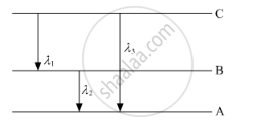
(ii) Find the relation between three wavelengths λ1, λ2 and λ3 from the energy-level diagram shown below.
The energy associated with the first orbit in the hydrogen atom is - 2.18 × 10⁻¹⁸ J atom-1. What is the energy associated with the fifth orbit?
Calculate the energy required for the process
\[\ce{He^+_{(g)} -> He^{2+}_{(g)} + e^-}\]
The ionization energy for the H atom in the ground state is 2.18 ×10⁻¹⁸ J atom–1
The radius of the innermost electron orbit of a hydrogen atom is 5.3 × 10⁻¹¹ m. What are the radii of the n = 2 and n = 3 orbits?
Find the wavelength of the radiation emitted by hydrogen in the transitions (a) n = 3 to n= 2, (b) n = 5 to n = 4 and (c) n = 10 to n = 9.
A neutron moving with a speed υ strikes a hydrogen atom in ground state moving towards it with the same speed. Find the minimum speed of the neutron for which inelastic (completely or partially) collision may take place. The mass of neutron = mass of hydrogen = 1.67 × 10⁻²⁷ kg.v
A filter transmits only the radiation of wavelength greater than 440 nm. Radiation from a hydrogen-discharge tube goes through such a filter and is incident on a metal of work function 2.0 eV. Find the stopping potential which can stop the photoelectrons.
The dissociation constant of a weak base (BOH) is 1.8 × 10⁻⁵. Its degree of dissociation in 0.001 M solution is ____________.
A particle has a mass of 0.002 kg and uncertainty in its velocity is 9.2 × 10⁻⁶ m/s, then uncertainty in position is ≥ ____________.
(h = 6.6 × 10⁻³⁴ J s)
The energy associated with the first orbit of He+ is ____________ J.
For an electron in the second orbit of hydrogen, what is the moment of momentum as per the Bohr's model?
The wavelength in Å of the photon that is emitted when an electron in Bohr orbit with n = 2 returns to orbit with n = 1 in H atom is ______ Å. The ionisation potential of the ground state of the H-atom is 2.17 × 10⁻¹¹ erg.
In Bohr's theory of hydrogen atom, the electron jumps from higher orbit n to lower orbit p. The wavelength will be minimum for the transition ______.
According to Bohr's theory, the radius of the nth Bohr orbit of a hydrogen like atom of atomic number Z is proportional to ______.
The wavelength of the second line of the Balmer series in the hydrogen spectrum is 4861 Å. Calculate the wavelength of the first line of the same series.
For the reaction \[\ce{2NO2 (g) ⇌ N2O4(g)}\], when ΔS = −176.0 JK−1 and ΔH = −57.8 kj mol−1, the magnitude of ΔG at 298 K for the reaction is ______ kJ mol−1. (Nearest integer)
Calculate the shortest wavenumber in hydrogen spectrum of Lyman series. (RH = 109677 cm−1)
What happens to an electron revolving in a circular orbit according to classical electromagnetic theory?
Which expression gives the orbital frequency used to calculate the initial frequency of light emitted under classical electromagnetic theory?
