Advertisements
Advertisements
प्रश्न
Suppose, the electron in a hydrogen atom makes transition from n = 3 to n = 2 in 10−8 s. The order of the torque acting on the electron in this period, using the relation between torque and angular momentum as discussed in the chapter on rotational mechanics is
विकल्प
10−34 N m
10−24 N m
10−42 N m
10−8 N m
Advertisements
उत्तर
10−42 N-m
The angular momentum of the electron for the nth state is given by
`L_n = (nh)/(2pi)`
Angular momentum of the electron for n = 3,
n = 3 , `L_i = (3h)/(2pi)`
Angular momentum of the electron for n = 2, `L_f= (2h)/(2pi)`
The torque is the time rate of change of the angular momentum.
Torque `tau = (L_f - L_i)/t`
= `((2h//2pi)-(3h//2pi))/10^-8`
= `-(h//2pi)/((10^-8)`
= `(-10^-34)/10^-8 ..............[∴ h/(2pi) ≈ 10^-34 J -s ]`
= -10-42 N - m
The magnitude of the torque is `10^-42 N.m`
APPEARS IN
संबंधित प्रश्न
(i) State Bohr's quantization condition for defining stationary orbits. How does the de Broglie hypothesis explain the stationary orbits?
(ii) Find the relation between three wavelengths λ1, λ2 and λ3 from the energy-level diagram shown below.
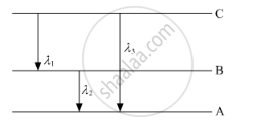
On the basis of Bohr's theory, derive an expression for the radius of the nth orbit of an electron of the hydrogen atom.
Using Bohr’s postulates, obtain the expressions for (i) kinetic energy and (ii) potential energy of the electron in stationary state of hydrogen atom.
Draw the energy level diagram showing how the transitions between energy levels result in the appearance of Lymann Series.
The Bohr radius is given by `a_0 = (∈_0h^2)/{pime^2}`. Verify that the RHS has dimensions of length.
A beam of light having wavelengths distributed uniformly between 450 nm to 550 nm passes through a sample of hydrogen gas. Which wavelength will have the least intensity in the transmitted beam?
Write postulates of Bohr’s Theory of hydrogen atom.
The spectral line obtained when an electron jumps from n = 5 to n = 2 level in hydrogen atom belongs to the ____________ series.
According to Bohr’s theory, the angular momentum of an electron in 5th orbit is ______.
In Bohr model of hydrogen atom, which of the following is quantised?
Ratio of longest to shortest wavelength in Balmer series is ______.
Consider two different hydrogen atoms. The electron in each atom is in an excited state. Is it possible for the electrons to have different energies but same orbital angular momentum according to the Bohr model? Justify your answer.
A hydrogen atom in is ground state absorbs 10.2 eV of energy. The angular momentum of electron of the hydrogen atom will increase by the value of ______.
(Given, Planck's constant = 6.6 × 10⁻³⁴ Js)
What is the energy of an electron in stationary state corresponding to n = 2?
Oxygen is 16 times heavier than hydrogen. Equal volumes of hydrogen and oxygen are mixed. The ratio of speed of sound in the mixture to that in hydrogen is ______.
An electron in a hydrogen atom has an energy of -3.4 eV. The difference between its kinetic and potential energy is ______.
What is meant by ionisation energy?
How much is the angular momentum of an electron when it is orbiting in the second Bohr orbit of hydrogen atom?
Calculate the radius of the second orbit of He+.
Which from following is CORREСТ relationship between wavelength and momentum of electron?
If a revolving electron emitted radiation continuously, what would equal the frequency of emitted radiation?
