Advertisements
Advertisements
प्रश्न
Use Bohr’s model of hydrogen atom to obtain the relationship between the angular momentum and the magnetic moment of the revolving electron.
Advertisements
उत्तर
In the Bohr model of the hydrogen atom, the electron is modeled as a point negative charge rotating in a circular orbit about a fixed axis about a nucleus.
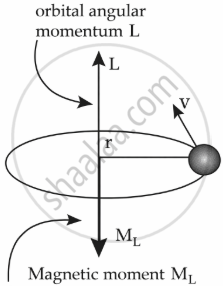
Let us consider,
r = radius of the orbit
v = velocity
e = charge of electron
m = mass of electron
Time period (T) = `"circumference"/"velocity"`
= `(2 pi r)/v`
Current (I) = `(-e)/T`
= `(-e)/((2 pi r)/v)`
= `(-e v)/(2 pi r)`
The magnetic moment due to a current loop enclosing an area A is given by:
ML = IA
= `(-e V)/(2 pi r) xx A`
= `(-e v)/(2 pi r) xx pi r^2`
= `(-e r v)/2`
= `(-m e r v)/(2 m)`
L = Angular momentum = mvr
So, ML = `(-e)/(2 m) L`
संबंधित प्रश्न
Using Bohr's postulates of the atomic model, derive the expression for radius of nth electron orbit. Hence obtain the expression for Bohr's radius.
How many electrons in an atom may have the following quantum numbers?
n = 3, l = 0
Calculate the energy required for the process
\[\ce{He^+_{(g)} -> He^{2+}_{(g)} + e^-}\]
The ionization energy for the H atom in the ground state is 2.18 ×10⁻¹⁸ J atom–1
Which of the following parameters are the same for all hydrogen-like atoms and ions in their ground states?
How are various lines of Lyman series formed? Explain on the basis of Bohr’s theory.
When an electron falls from a higher energy to a lower energy level, the difference in the energies appears in the form of electromagnetic radiation. Why cannot it be emitted as other forms of energy?
The first ionization energy of H is 21.79 × 10⁻¹⁹ J. The second ionization energy of He atom is ______ × 10-19J.
How much is the angular momentum of an electron when it is orbiting in the second Bohr orbit of hydrogen atom?
Which conversion relates an electron volt to joules?
For an orbit radius of \[5.3\times10^{-11}\,\mathrm{m}\] and an electron velocity of \[2.2\times10^6\,\mathrm{m\,s^{-1}}\], what is the approximate initial frequency of emitted light according to classical electromagnetic theory?
