Advertisements
Advertisements
Question
Use Bohr’s model of hydrogen atom to obtain the relationship between the angular momentum and the magnetic moment of the revolving electron.
Advertisements
Solution
In the Bohr model of the hydrogen atom, the electron is modeled as a point negative charge rotating in a circular orbit about a fixed axis about a nucleus.
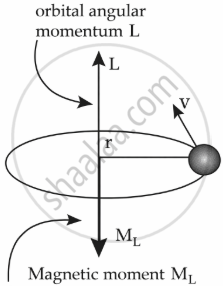
Let us consider,
r = radius of the orbit
v = velocity
e = charge of electron
m = mass of electron
Time period (T) = `"circumference"/"velocity"`
= `(2 pi r)/v`
Current (I) = `(-e)/T`
= `(-e)/((2 pi r)/v)`
= `(-e v)/(2 pi r)`
The magnetic moment due to a current loop enclosing an area A is given by:
ML = IA
= `(-e V)/(2 pi r) xx A`
= `(-e v)/(2 pi r) xx pi r^2`
= `(-e r v)/2`
= `(-m e r v)/(2 m)`
L = Angular momentum = mvr
So, ML = `(-e)/(2 m) L`
RELATED QUESTIONS
Hydrogen atom has only one electron, so mutual repulsion between electrons is absent. However, in multielectron atoms mutual repulsion between the electrons is significant. How does this affect the energy of an electron in the orbitals of the same principal quantum number in multielectron atoms?
Consider two different hydrogen atoms. The electron in each atom is in an excited state. Is it possible for the electrons to have different energies but same orbital angular momentum according to the Bohr model? Justify your answer.
The wavelength of the first time line of Ballmer series is 6563 A°. The Rydberg constant for hydrogen is about:-
The ratio of the ionization energy of H and Be+3 is ______.
The energy required to remove the electron from a singly ionized Helium atom is 2.2 times the energy required to remove an electron from Helium atom. The total energy required to ionize the Helium atom completely is ______.
The line at 434 nm in the Balmer series of the hydrogen spectrum corresponds to a transition of an electron from the nth to second Bohr orbit. The value of n is ______.
A 100 eV electron collides with a stationary helium ion (He+) in its ground state and exits to a higher level. After the collision, He+ ions emit two photons in succession with wavelengths 1085 Å and 304 Å. The energy of the electron after the collision will be ______ eV.
Given h = 6.63 × 10⁻³⁴ Js.
The figure below is the Energy level diagram for the Hydrogen atom. Study the transitions shown and answer the following question:
- State the type of spectrum obtained.
- Name the series of spectrum obtained.

What is the velocity of an electron in the 3rd orbit of hydrogen atom if its velocity in the 1st orbit is v0?
For an orbit radius of \[5.3\times10^{-11}\,\mathrm{m}\] and an electron velocity of \[2.2\times10^6\,\mathrm{m\,s^{-1}}\], what is the approximate initial frequency of emitted light according to classical electromagnetic theory?
