Advertisements
Advertisements
प्रश्न
A neutron moving with a speed υ strikes a hydrogen atom in ground state moving towards it with the same speed. Find the minimum speed of the neutron for which inelastic (completely or partially) collision may take place. The mass of neutron = mass of hydrogen = 1.67 × 10⁻²⁷ kg.v
Advertisements
उत्तर
Given:
Mass of neutron, m = 1.67 × 10⁻²⁷ kg
Since neutron is moving with velocity (v), its energy (E) is given by
`E = 1/2 mv ^2`
Let the energy absorbed be ∆E.
The condition for inelastic collision is given below:
`1/2mv^2 > 2 Delta E`
`rArr DeltaE < 1/4 mv^2`
Since 10.2 eV, energy is required for the first excited state.
`therefore DeltaE < 10.2 eV `
`therefore 10.2 eV < 1/4 mv^2`
Thus, minimum speed of the neutron is given by
`rArr v_min = sqrt((4xx10.2)/m eV`
`rArr v_min = sqrt((10.2xx1.6xx10^19xx4)/(1.67xx10^-27)`
= 6 × 10⁴ m/sec
APPEARS IN
संबंधित प्रश्न
Obtain an expression for the radius of Bohr orbit for H-atom.
(i) State Bohr's quantization condition for defining stationary orbits. How does the de Broglie hypothesis explain the stationary orbits?
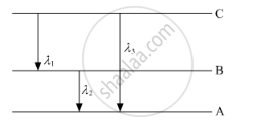
(ii) Find the relation between three wavelengths λ1, λ2 and λ3 from the energy-level diagram shown below.
Using Bohr's postulates of the atomic model, derive the expression for radius of nth electron orbit. Hence obtain the expression for Bohr's radius.
Find the frequency of revolution of an electron in Bohr’s 2nd orbit; if the radius and speed of electron in that orbit is 2.14 × 10⁻¹⁰ m and 1.09 × 10⁶ m/s respectively. [π= 3.142]
The radius of the innermost electron orbit of a hydrogen atom is 5.3 × 10⁻¹¹ m. What are the radii of the n = 2 and n = 3 orbits?
The numerical value of ionization energy in eV equals the ionization potential in volts. Does the equality hold if these quantities are measured in some other units?
When a photon stimulates the emission of another photon, the two photons have
(a) same energy
(b) same direction
(c) same phase
(d) same wavelength
The Bohr radius is given by `a_0 = (∈_0h^2)/{pime^2}`. Verify that the RHS has dimensions of length.
Evaluate Rydberg constant by putting the values of the fundamental constants in its expression.
According to Maxwell's theory of electrodynamics, an electron going in a circle should emit radiation of frequency equal to its frequency of revolution. What should be the wavelength of the radiation emitted by a hydrogen atom in ground state if this rule is followed?
The light emitted in the transition n = 3 to n = 2 in hydrogen is called Hα light. Find the maximum work function a metal can have so that Hα light can emit photoelectrons from it.
Consider a neutron and an electron bound to each other due to gravitational force. Assuming Bohr's quantization rule for angular momentum to be valid in this case, derive an expression for the energy of the neutron-electron system.
Obtain Bohr’s quantisation condition for angular momentum of electron orbiting in nth orbit in hydrogen atom on the basis of the wave picture of an electron using de Broglie hypothesis.
When the electron orbiting in hydrogen atom in its ground state moves to the third excited state, show how the de Broglie wavelength associated with it would be affected.
The angular momentum of electron in nth orbit is given by
According to Bhor' s theory the moment of momentum of an electron revolving in second orbit of hydrogen atom will be.
The wavelength in Å of the photon that is emitted when an electron in Bohr orbit with n = 2 returns to orbit with n = 1 in H atom is ______ Å. The ionisation potential of the ground state of the H-atom is 2.17 × 10⁻¹¹ erg.
What is the energy of an electron in stationary state corresponding to n = 2?
Which conversion relates an electron volt to joules?
For an orbit radius of \[5.3\times10^{-11}\,\mathrm{m}\] and an electron velocity of \[2.2\times10^6\,\mathrm{m\,s^{-1}}\], what is the approximate initial frequency of emitted light according to classical electromagnetic theory?
