Advertisements
Advertisements
Question
A neutron moving with a speed υ strikes a hydrogen atom in ground state moving towards it with the same speed. Find the minimum speed of the neutron for which inelastic (completely or partially) collision may take place. The mass of neutron = mass of hydrogen = 1.67 × 10⁻²⁷ kg.v
Advertisements
Solution
Given:
Mass of neutron, m = 1.67 × 10⁻²⁷ kg
Since neutron is moving with velocity (v), its energy (E) is given by
`E = 1/2 mv ^2`
Let the energy absorbed be ∆E.
The condition for inelastic collision is given below:
`1/2mv^2 > 2 Delta E`
`rArr DeltaE < 1/4 mv^2`
Since 10.2 eV, energy is required for the first excited state.
`therefore DeltaE < 10.2 eV `
`therefore 10.2 eV < 1/4 mv^2`
Thus, minimum speed of the neutron is given by
`rArr v_min = sqrt((4xx10.2)/m eV`
`rArr v_min = sqrt((10.2xx1.6xx10^19xx4)/(1.67xx10^-27)`
= 6 × 10⁴ m/sec
APPEARS IN
RELATED QUESTIONS
State Bohr’s third postulate for hydrogen (H2) atom. Derive Bohr’s formula for the wave number. Obtain expressions for longest and shortest wavelength of spectral lines in ultraviolet region for hydrogen atom
(i) State Bohr's quantization condition for defining stationary orbits. How does the de Broglie hypothesis explain the stationary orbits?
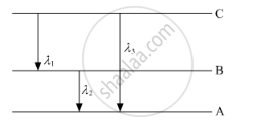
(ii) Find the relation between three wavelengths λ1, λ2 and λ3 from the energy-level diagram shown below.
The energy associated with the first orbit in the hydrogen atom is - 2.18 × 10⁻¹⁸ J atom-1. What is the energy associated with the fifth orbit?
In Bohr’s model of the hydrogen atom, the radius of the first orbit of an electron is r0 . Then, the radius of the third orbit is:
a) `r_0/9`
b) `r_0`
c) `3r_0`
d) `9r_0`
In a laser tube, all the photons
When a photon stimulates the emission of another photon, the two photons have
(a) same energy
(b) same direction
(c) same phase
(d) same wavelength
Radiation coming from transition n = 2 to n = 1 of hydrogen atoms falls on helium ions in n = 1 and n = 2 states. What are the possible transitions of helium ions as they absorbs energy from the radiation?
A beam of monochromatic light of wavelength λ ejects photoelectrons from a cesium surface (Φ = 1.9 eV). These photoelectrons are made to collide with hydrogen atoms in ground state. Find the maximum value of λ for which (a) hydrogen atoms may be ionized, (b) hydrogen atoms may get excited from the ground state to the first excited state and (c) the excited hydrogen atoms may emit visible light.
The spectral line obtained when an electron jumps from n = 5 to n = 2 level in hydrogen atom belongs to the ____________ series.
The binding energy of a H-atom, considering an electron moving around a fixed nuclei (proton), is B = `- (Me^4)/(8n^2ε_0^2h^2)`. (m = electron mass). If one decides to work in a frame of reference where the electron is at rest, the proton would be moving around it. By similar arguments, the binding energy would be
B = `- (Me^4)/(8n^2ε_0^2h^2)` (M = proton mass)
This last expression is not correct because ______.
The Bohr model for the spectra of a H-atom ______.
- will not be applicable to hydrogen in the molecular from.
- will not be applicable as it is for a He-atom.
- is valid only at room temperature.
- predicts continuous as well as discrete spectral lines.
When an electron falls from a higher energy to a lower energy level, the difference in the energies appears in the form of electromagnetic radiation. Why cannot it be emitted as other forms of energy?
The inverse square law in electrostatics is |F| = `e^2/((4πε_0).r^2)` for the force between an electron and a proton. The `(1/r)` dependence of |F| can be understood in quantum theory as being due to the fact that the ‘particle’ of light (photon) is massless. If photons had a mass mp, force would be modified to |F| = `e^2/((4πε_0)r^2) [1/r^2 + λ/r]`, exp (– λr) where λ = mpc/h and h = `h/(2π)`. Estimate the change in the ground state energy of a H-atom if mp were 10-6 times the mass of an electron.
The ground state energy of hydrogen atoms is -13.6 eV. The photon emitted during the transition of electron from n = 3 to n = 1 unknown work function. The photoelectrons are emitted from the material with a maximum kinetic energy of 9 eV. Calculate the threshold wavelength of the material used.
The electron in a hydrogen atom first jumps from the third excited state to the second excited state and subsequently to the first excited state. The ratio of the respective wavelengths, λ1/λ2, of the photons emitted in this process is ______.
The first ionization energy of H is 21.79 × 10⁻¹⁹ J. The second ionization energy of He atom is ______ × 10-19J.
Hydrogen atom from excited state comes to the ground state by emitting a photon of wavelength λ. If R is the Rydberg constant then the principal quantum number n of the excited state is ______.
Using Bohr’s Theory of hydrogen atom, obtain an expression for the velocity of an electron in the nth orbit of an atom.
If a revolving electron emitted radiation continuously, what would equal the frequency of emitted radiation?
Which expression gives the orbital frequency used to calculate the initial frequency of light emitted under classical electromagnetic theory?
