Advertisements
Advertisements
Question
Using Bohr’s postulates for hydrogen atom, show that the total energy (E) of the electron in the stationary states tan be expressed as the sum of kinetic energy (K) and potential energy (U), where K = −2U. Hence deduce the expression for the total energy in the nth energy level of hydrogen atom.
Advertisements
Solution
According to Bohr’s postulates for hydrogen atom electron revolves in a circular orbit around the heavy positively charged nucleus. These are the stationary (orbits) states of the atom.
For a particular orbit, electron is moves there, so it has kinetic energy.
Also, there is potential energy due to charge on electron and heavy positively charged nucleons.
Hence, total energy (E) of atom is sum of kinetic energy (K) and potential energy (U).
`i.e. E =K+U`
Let us assume that the nucleus has a positive charge Ze. An electron moving with a constant speed v along a circle of radius of r with centre at the nucleus.
Force acting on e− due to nucleus is given by
`F =(Ze^2)/(4piin_0r^2)`
The acceleration of electron `v^2/r`(towards the centre)
If, m = mass of an electron
Then, from Newton’s 2nd Law.
`F =m(V_2/r)`
`=>Ze^2/(4piin_0r^2) = m(V^2/r)`
`=>r = (Ze^2)/(4piin_0 mv^2) ..... (1)`
From Bohr’s quantization rules
`mvr = n h/2pi ... (2)`
Where n = a positive integer
Plug-in the value of r from equation (i)
`mv*(Ze^2)/(4piin_0 (mv^2)) = n h/(2pi)`
`v=(Ze^2)/(2in_0hn) ..... (3)`
So, kinetic energy `k = 1/2mv^2`
`= (mZ^2e^4)/(8in_0^2 h^2 n^2) ..... (4)`
Potential energy of the atom
`U =-(Ze^2)/(4piin_0r) .... (5)`
Using (iii) in equation (i),
`r = (Ze^2)/(4piin_0 m(Ze^2)^2/(2in_0 hn)^2`
`=(4in_0^2 h^2 n^2)/((4piin_0)mZe^2`
` r =(in_0h^2n^2)/(pimZe^2)`
Using value of r, in equation (v)
`U = (-Ze^2)/(4piin_0 ((in_0h^2 n^2)/(pimZe^2)))`
`U = (-Z^2e^4)/(4in_0^2 h^2n^2)`
So, the total energy,
E = K + U
`= +(Z^2e^4)/(8in_0^2 h^2 n^2) - (Z^2e^4)/(4in_0^2 h^2 n^2)`
`= - (Z^2e^2)/(8in_0^2 h^2 n^2)`
RELATED QUESTIONS
(i) State Bohr's quantization condition for defining stationary orbits. How does the de Broglie hypothesis explain the stationary orbits?
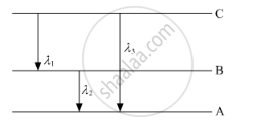
(ii) Find the relation between three wavelengths λ1, λ2 and λ3 from the energy-level diagram shown below.
What is the energy in joules, required to shift the electron of the hydrogen atom from the first Bohr orbit to the fifth Bohr orbit and what is the wavelength of the light emitted when the electron returns to the ground state? The ground state electron energy is –2.18 × 10⁻¹¹ ergs.
In Bohr’s model of the hydrogen atom, the radius of the first orbit of an electron is r0 . Then, the radius of the third orbit is:
a) `r_0/9`
b) `r_0`
c) `3r_0`
d) `9r_0`
In a laser tube, all the photons
Calculate the magnetic dipole moment corresponding to the motion of the electron in the ground state of a hydrogen atom.
The light emitted in the transition n = 3 to n = 2 in hydrogen is called Hα light. Find the maximum work function a metal can have so that Hα light can emit photoelectrons from it.
Obtain Bohr’s quantisation condition for angular momentum of electron orbiting in nth orbit in hydrogen atom on the basis of the wave picture of an electron using de Broglie hypothesis.
The energy of an electron in hth orbit of hydrogen atom is –13.6/n2ev energy required to excite the electron from the first orbit to the third orbit is
State the Bohr's postulate of angular momentum of an electron.
Which expression gives the quantised angular momentum of the orbiting electron?
