Advertisements
Advertisements
Question
Explain, giving reasons, which of the following sets of quantum numbers are not possible.
- n = 0, l = 0, ml = 0, ms = + ½
- n = 1, l = 0, ml = 0, ms = – ½
- n = 1, l = 1, ml = 0, ms = + ½
- n = 2, l = 1, ml = 0, ms = – ½
- n = 3, l = 3, ml = –3, ms = + ½
- n = 3, l = 1, ml = 0, ms = + ½
Advertisements
Solution
a. n = 0, l = 0, mₗ = 0, mₛ = +½
Not possible, because n cannot be 0.
b. n = 1, l = 0, mₗ = 0, mₛ = –½
Possible, because all values follow rules (l < n, mₗ = 0, valid mₛ).
c. n = 1, l = 1, mₗ = 0, mₛ = +½
Not possible, because for n = 1, l must be 0 (since l = 0 to n – 1).
d. n = 2, l = 1, mₗ = 0, mₛ = –½
Possible, all values valid.
e. n = 3, l = 3, mₗ = –3, mₛ = +½
Not possible, because l cannot be equal to n; it must be less than n.
f. n = 3, l = 1, mₗ = 0, mₛ = +½
Possible, all values valid.
APPEARS IN
RELATED QUESTIONS
(i) State Bohr's quantization condition for defining stationary orbits. How does the de Broglie hypothesis explain the stationary orbits?
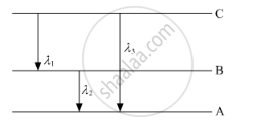
(ii) Find the relation between three wavelengths λ1, λ2 and λ3 from the energy-level diagram shown below.
The ratio of kinetic energy of an electron in Bohr’s orbit to its total energy in the same orbit is
(A) – 1
(B) 2
(C) 1/2
(D) – 0.5
In accordance with the Bohr’s model, find the quantum number that characterises the earth’s revolution around the sun in an orbit of radius 1.5 × 10¹¹ m with orbital speed 3 × 10⁴ m/s. (Mass of earth = 6.0 × 1024 kg)
Using Bohr's postulates, derive the expression for the orbital period of the electron moving in the nth orbit of hydrogen atom ?
Using Bohr's postulates, derive the expression for the total energy of the electron in the stationary states of the hydrogen atom ?
Radiation coming from transition n = 2 to n = 1 of hydrogen atoms falls on helium ions in n = 1 and n = 2 states. What are the possible transitions of helium ions as they absorbs energy from the radiation?
A beam of monochromatic light of wavelength λ ejects photoelectrons from a cesium surface (Φ = 1.9 eV). These photoelectrons are made to collide with hydrogen atoms in ground state. Find the maximum value of λ for which (a) hydrogen atoms may be ionized, (b) hydrogen atoms may get excited from the ground state to the first excited state and (c) the excited hydrogen atoms may emit visible light.
Mention demerits of Bohr’s Atomic model.
A particle has a mass of 0.002 kg and uncertainty in its velocity is 9.2 × 10⁻⁶ m/s, then uncertainty in position is ≥ ____________.
(h = 6.6 × 10⁻³⁴ J s)
The radius of the third Bohr orbit for hydrogen atom is ____________.
Which of these statements correctly describe the atomic model according to classical electromagnetic theory?
Find the ratio of energies of photons produced due to transition of an election of hydrogen atom from its (i) second permitted energy level to the first level. and (ii) the highest permitted energy level to the first permitted level.
Orbits of a particle moving in a circle are such that the perimeter of the orbit equals an integer number of de-Broglie wavelengths of the particle. For a charged particle moving in a plane perpendicular to a magnetic field, the radius of the nth orbital will therefore be proportional to:
The total energy of an electron in the nth orbit of the hydrogen atom is proportional to ______.
The radius of the nth orbit in the Bohr model of hydrogen is proportional to ______.
State the Bohr's postulate of angular momentum of an electron.
The de Broglie wavelength of an electron in the first Bohr’s orbit of hydrogen atom is equal to ______.
Which law of force governs the nucleus-electron system?
If a revolving electron emitted radiation continuously, what would equal the frequency of emitted radiation?
What spectrum would an atom emit if its electron spiralled inward while emitting radiation continuously?
