Advertisements
Advertisements
Question
Two cells of emf E1, E2 and internal resistance r1 and r2 respectively are connected in parallel as shown in the figure.
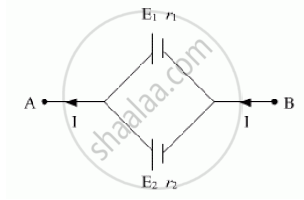
Deduce the expressions for
(1) the equivalent e.m.f of the combination
(2) the equivalent resistance of the combination, and
(3) the potential difference between the point A and B.
Advertisements
Solution

Let I1 and I2 be the current in two cells with emf E1 and E2 and internal resistance r1 and r2
So I = I1 + I2
Now let V be the potential difference between the points A and B. Since the first cell is connected between the points A and B.
V = potential difference across first cell
V = E1 − I1r1
`or I_1 =(E_1-V)/r_1`
Now, the second cell is also connected between the points A and B. So,
`or I_2 =(E_2-V)/r_2`
Thus, substituting for I1 and I2
`I =(E_1-V)/r_1 + (E_2-V)/r_2`
`or, I (E_1 /r_1 + E_2 /r_2)-V(1 /r_1 +1 /r_2)`
`V =((E_1r_2 + E_2r_1)/(r_1+r_2)) -I((r_1r_2)/(r_1 +r_2)) ..... (1)`
If E is effective e.m.f and r, the effective internal resistance of the parallel combination of the two cells then V = E − Ir …..(2)
Comparing (1) and (2)
`(1) E= (E_1r_2 + E_2r_1)/(r_1+r_2)`
This is equivalent e.m.f of the combination
`(2)r =(r_1r_2)/(r_1 +r_2)`
This is equivalent resistance of the combination.
(3) The potential difference between the point A and B is
V = E − Ir
RELATED QUESTIONS
Two cells of emfs 1.5 V and 2.0 V, having internal resistances 0.2 Ω and 0.3 Ω, respectively, are connected in parallel. Calculate the emf and internal resistance of the equivalent cell.
Distinguish between emf and terminal voltage of a cell.
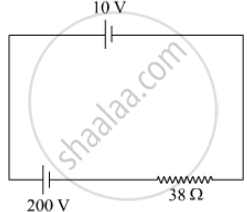
A 10 V cell of negligible internal resistance is connected in parallel across a battery of emf 200 V and internal resistance 38 Ω as shown in the figure. Find the value of current in the circuit.
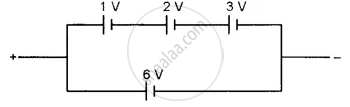
Find the emf of the battery shown in the figure:
Three cells, each of emf E but internal resistances 2r, 3r and 6r are connected in parallel across a resistor R.
Obtain expressions for (i) current flowing in the circuit, and (ii) the terminal potential differences across the equivalent cell.
The emf of a cell is defined as the work done in carrying a unit positive charge through which part of the circuit?
Internal resistance of a cell is the resistance offered by which component?
During charging of a cell, how does terminal voltage (V) compare to EMF (ε)?
During discharging, chemical energy is converted to:
