Advertisements
Advertisements
Question
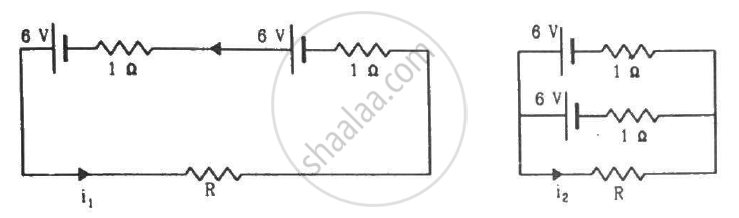
Find the value of i1/i2 in the following figure if (a) R = 0.1 Ω (b) R = 1 Ω and (c) R = 10 Ω. Note from your answers that in order to get more current from a combination of two batteries, they should be joined in parallel if the external resistance is small and in series if the external resistance is large, compared to the internal resistance.
Advertisements
Solution
(a) For R = 0.1 Ω
Applying KVL in the given circuit, we get:-
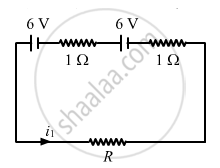
\[0 . 1 i_1 + 1 i_1 - 6 + 1 i_1 - 6 = 0\]
\[ \Rightarrow 0 . 1 i_1 + 1 i_1 + 1 i_1 = 12\]
\[ \Rightarrow i_1 = \frac{12}{\left( 2 . 1 \right)} = 5 . 71 A\]
Now, consider the given circuit.
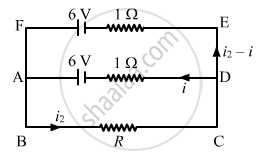
Applying KVL in the loop ABCDA, we get:-
\[0 . 1 i_2 + 1i - 6 = 0\]
\[ \Rightarrow 0 . 1 i_2 + i = 6\]
\[ \Rightarrow i = 6 - 0 . 1 i_2\]
Applying KVL in ADEFA, we get:-
\[i - 6 + 6 - \left( i_2 - i \right)1 = 0\]
\[ \Rightarrow i - i_2 + i = 0\]
\[ \Rightarrow 2i - i_2 = 0\]
\[ \Rightarrow 2\left[ 6 - 0 . 1 i_2 \right] - i_2 = 0\]
\[ \Rightarrow i_2 = 10 A\]
\[\therefore \frac{i_1}{i_2} = 0 . 571\]
(b) For R = 1 Ω
Applying KVL in the circuit given in figure 1, we get:-
\[1 i_1 + 1 . i_1 - 6 + i_1 - 6 = 0\]
\[ \Rightarrow 3 i_1 = 12\]
\[ \Rightarrow i_1 = 4\]
Now, for figure 2:-
Applying KVL in ABCDA, we get:-
\[i_2 + i - 6 = 0\]
\[ \Rightarrow i_2 + i = 6\]
Applying KVL in ADEFA, we get:-
\[i - 6 + 6 - \left( i_2 - i \right)1 = 0\]
\[ \Rightarrow i - i_2 + i = 0\]
\[ \Rightarrow 2i - i_2 = 0\]
\[ \Rightarrow 2\left[ 6 - i_2 \right] - i_2 = 0\]
\[ \Rightarrow 12 - 3 i_2 = 0\]
\[ \Rightarrow i_2 = 4 A\]
\[ \therefore \frac{i_1}{i_2} = 1\]
(c) For R = 10 Ω
Applying KVL in the circuit given in figure 1, we get:-
\[10 i_1 + 1 i_1 - 6 + 1 i_1 - 6 = 0\]
\[\Rightarrow 12 i_1 = 12\]
\[ \Rightarrow i_1 = 1\]
Now, for figure 2:-
Applying KVL in ABCDA, we get:-
\[10 i_2 + i - 6 = 0\]
\[ \Rightarrow i = 6 - 10 i_2\]
Applying KVL in ADEFA, we get:-
\[i - 6 + 6 - \left( i_2 - i \right)1 = 0\]
\[ \Rightarrow i - i_2 + i = 0\]
\[ \Rightarrow 2i - i_2 = 0\]
\[ \Rightarrow 2\left[ 6 - 10 i_2 \right] - i_2 = 0\]
\[ \Rightarrow 12 - 21 i_2 = 0\]
\[ \Rightarrow i_2 = 0 . 57 A\]
\[ \therefore \frac{i_1}{i_2} = 1 . 75\]
APPEARS IN
RELATED QUESTIONS
A cell of emf 'E' and internal resistance 'r' is connected across a variable load resistor R. Draw the plots of the terminal voltage V versus (i) R and (ii) the current I.
It is found that when R = 4 Ω, the current is 1 A and when R is increased to 9 Ω, the current reduces to 0.5 A. Find the values of the emf E and internal resistance r.
A storage battery of emf 8.0 V and internal resistance 0.5 Ω is being charged by a 120 V dc supply using a series resistor of 15.5 Ω. What is the terminal voltage of the battery during charging? What is the purpose of having a series resistor in the charging circuit?
A secondary cell after long use has an emf of 1.9 V and a large internal resistance of 380 Ω. What maximum current can be drawn from the cell? Could the cell drive the starting motor of a car?
Nichrome and copper wires of same length and same radius are connected in series. Current I is passed through them. Which wire gets heated up more? Justify your answer.
A long straight current carrying wire passes normally through the centre of circular loop. If the current through the wire increases, will there be an induced emf in the loop? Justify.
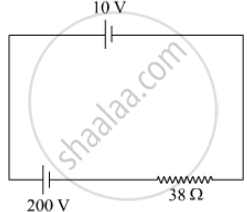
A 10 V cell of negligible internal resistance is connected in parallel across a battery of emf 200 V and internal resistance 38 Ω as shown in the figure. Find the value of current in the circuit.
A cell of emf ‘E’ and internal resistance ‘r’ is connected across a variable resistor ‘R’. Plot a graph showing the variation of terminal potential ‘V’ with resistance R. Predict from the graph the condition under which ‘V’ becomes equal to ‘E’.
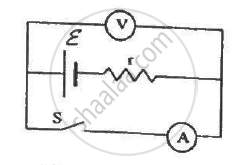
The following figure shows an arrangement to measure the emf ε and internal resistance r of a battery. The voltmeter has a very high resistance and the ammeter also has some resistance. The voltmeter reads 1.52 V when the switch S is open. When the switch is closed, the voltmeter reading drops to 1.45 V and the ammeter reads 1.0 A. Find the emf and the internal resistance of the battery.
The temperatures of the junctions of a bismuth-silver thermocouple are maintained at 0°C and 0.001°C. Find the thermo-emf (Seebeck emf) developed. For bismuth-silver, a = − 46 × 10−6 V°C−1 and b = −0.48 × 10⁻⁶ V°C−2.
A conductor of length ‘l’ is rotated about one of its ends at a constant angular speed ‘ω’ in a plane perpendicular to a uniform magnetic field B. Plot graphs to show variations of the emf induced across the ends of the conductor with
- angular speed ω and
- length of the conductor l.
Two cells of emfs approximately 5 V and 10 V are to be accurately compared using a potentiometer of length 400 cm.
Two batteries of emf ε1 and ε2 (ε2 > ε1) and internal resistances r1 and r2 respectively are connected in parallel as shown in figure.

A cell E1 of emf 6 V and internal resistance 2 Ω is connected with another cell E2 of emf 4 V and internal resistance 8 Ω (as shown in the figure). The potential difference across points X and Y is ______.

A block of metal is heated directly by dissipating power in the internal resistance of block. Because of temperature rise, the resistance increases exponentially with time and is given by R(t) = 0.5 e2t, where t is in second. The block is connected across a 110 V source and dissipates 7644 J heat energy over a certain period of time. This period of time is ______ × 10-1 sec (take ln 0.367 = -1).
A wire of length ‘l’ and resistance 100 Ω is divided into 10 equal parts. The first 5 parts are connected in series while the next 5 parts are connected in parallel. The two combinations are again connected in series. The resistance of this final combination is ______.
The relationship between terminal potential difference (V), EMF (ε), current (I), and internal resistance (r) is given by:
Internal resistance of a cell is affected by the surface area of electrodes. As surface area increases, internal resistance:
