Advertisements
Advertisements
Question
Two identical cells of emf 1.5 V each joined in parallel, supply energy to an external circuit consisting of two resistances of 7 Ω each joined in parallel. A very high resistance voltmeter reads the terminal voltage of cells to be 1.4 V. Calculate the internal resistance of each cell.
Advertisements
Solution
The two cells are connected in parallel. So, the equivalent emf is 1.5 V.
Now, the two resistors are connected in parallel. So, the equivalent resistance is
`1/R_(eq)=1/R+1/R=2/R`
`:.R_(eq)=R/2=7/2=3.5Omega`
The terminal voltage of the cells measured by the voltmeter is 1.4 V.
The net internal resistance of the combination of cells is
`r_(eq)=((varepsilon-V)/V)R`
`:.r_(eq)=(1.5-1.4)/1.4xx3.5=0.1/1.4xx3.5=0.25 Omega`
Now, the individual internal resistors are connected in parallel. So, the individual internal resistances is
`r_(eq)=(r')/2`
∴ r' = 2req = 2 x 0.25 = 0.5Ω
APPEARS IN
RELATED QUESTIONS
The storage battery of a car has an emf of 12 V. If the internal resistance of the battery is 0.4 Ω, what is the maximum current that can be drawn from the battery?
A long straight current carrying wire passes normally through the centre of circular loop. If the current through the wire increases, will there be an induced emf in the loop? Justify.
Two cells of emf E1, E2 and internal resistance r1 and r2 respectively are connected in parallel as shown in the figure.
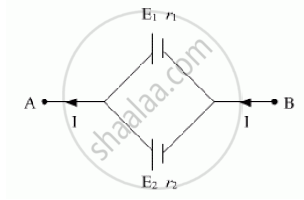
Deduce the expressions for
(1) the equivalent e.m.f of the combination
(2) the equivalent resistance of the combination, and
(3) the potential difference between the point A and B.
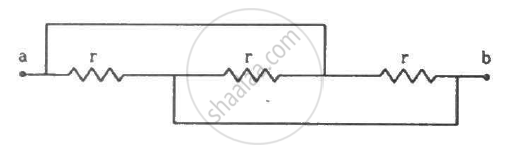
Find the equivalent resistance of the network shown in the figure between the points a and b.
Apply the first law of thermodynamics to a resistor carrying a current i. Identify which of the quantities ∆Q, ∆U and ∆W are zero, positive and negative.
A coil of resistance 100 Ω is connected across a battery of emf 6.0 V. Assume that the heat developed in the coil is used to raise its temperature. If the heat capacity of the coil is 4.0 J K−1, how long will it take to raise the temperature of the coil by 15°C?
If n cells each of emf e and internal resistance r are connected in parallel, then the total emf and internal resistance will be ______.
The internal resistance of a cell is the resistance of ______
Two batteries of emf ε1 and ε2 (ε2 > ε1) and internal resistances r1 and r2 respectively are connected in parallel as shown in figure.

What is the unit of EMF of a cell?
