Advertisements
Advertisements
Question
Find the electric field intensity due to a uniformly charged spherical shell at a point (i) outside the shell. Plot the graph of electric field with distance from the centre of the shell.
Advertisements
Solution
Let σ be the uniform surface charge density of a thin spherical shell of radius R
Field outside the shell: Consider a point P outside the shell with radius vector r.
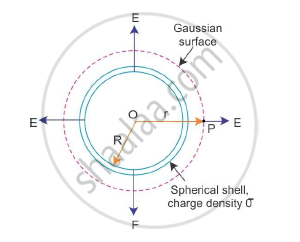
To calculate E at P, we take the Gaussian surface to be a sphere of radius r with centre O passing through P. All the points on this sphere are equivalent relative to the given charged configuration.
Therefore, the electric field at each point of the Gaussian surface has the same magnitude E and is along the radius vector at each point.
Thus, E and ΔS at every point are parallel, and the flux through each element is E ΔS. Summing over entire ΔS, the flux through the Gaussian surface is E × 4πr2. The charge enclosed is σ × 4πR2.
By Gauss’s law, we get
`Exx4pir^2=sigma/epsilon_0xx4piR^2`
`:.E=(sigmaR^2)/(epsilon_0r^2)=q/(4piepsilon_0r^2)`
Where q = 4πR2σ is the total charge on the spherical shell.
The electric field is directed outward if q > 0 and inward if q < 0. This however is exactly the field produced by a charge q placed at the centre O. Thus, for points outside the shell, the field caused by a uniformly charged shell is as if the entire charge of the shell is concentrated at its centre.
APPEARS IN
RELATED QUESTIONS
Use Gauss's law to find the electric field due to a uniformly charged infinite plane sheet. What is the direction of field for positive and negative charge densities?
A thin metallic spherical shell of radius R carries a charge Q on its surface. A point charge`Q/2` is placed at its centre C and an other charge +2Q is placed outside the shell at a distance x from the centre as shown in the figure. Find (i) the force on the charge at the centre of shell and at the point A, (ii) the electric flux through the shell.

Two large, thin metal plates are parallel and close to each other. On their inner faces, the plates have surface charge densities of opposite signs and of magnitude 17.0 × 10⁻²² C/m2. What is E:
- in the outer region of the first plate,
- in the outer region of the second plate, and
- between the plates?
Using Gauss’ law deduce the expression for the electric field due to a uniformly charged spherical conducting shell of radius R at a point
(i) outside and (ii) inside the shell.
Plot a graph showing variation of electric field as a function of r > R and r < R.
(r being the distance from the centre of the shell)
A spherical shell made of plastic, contains a charge Q distributed uniformly over its surface. What is the electric field inside the shell? If the shell is hammered to deshape it, without altering the charge, will the field inside be changed? What happens if the shell is made of a metal?
A large non-conducting sheet M is given a uniform charge density. Two uncharged small metal rods A and B are placed near the sheet as shown in the following figure.
(a) M attracts A.
(b) M attracts B.
(c) A attracts B.
(d) B attracts A.

A spherical volume contains a uniformly distributed charge of density 2.0 × 10 -4 Cm-3 Find the electric field at a point inside the volume at a distance 4⋅0 cm from the centre.
A circular wire-loop of radius a carries a total charge Q distributed uniformly over its length. A small length dL of the wire is cut off. Find the electric field at the centre due to the remaining wire.
“A uniformly charged conducting spherical shell for the points outside the shell behaves as if the entire charge of the shell is concentrated at its centre”. Show this with the help of a proper diagram and verify this statement.
