Advertisements
Advertisements
Question
Two batteries of emf ε1 and ε2 (ε2 > ε1) and internal resistances r1 and r2 respectively are connected in parallel as shown in figure.

Options
The equivalent emf εeq of the two cells is between ε1 and ε2, i.e. ε1 < εeq < ε2.
The equivalent emf εeq is smaller than ε1.
The εeq is given by εeq = ε1 + ε2 always.
εeq is independent of internal resistances r1 and r2.
Advertisements
Solution
The equivalent emf εeq of the two cells is between ε1 and ε2, i.e. ε1 < εeq < ε2.
Explanation:
The equivalent emf of this combination is given by
εeq = `(ε_1/r_1 + ε_1/r_2)/((1/r_1 + 1/r_2)) = (ε_1(1/r_1 + (ε_2/ε_1)/r_2))/((1/r_1 + 1/r_2)) = (ε_2((ε_1/ε_2)/r_1 + 1/r_2))/((1/r_1 + 1/r_2))`
As `ε_2/ε_1 > 1`
⇒ `((1/r_1 + (ε_2/r_1)/r_2))/((1/r_1 + 1/r_2)) > 1 or ε_(eq) > ε_1` also `ε_1/ε_2 < 1`
⇒ `(((ε_1/ε_2)/r_1 + 1/r_2))/((1/r_1 + 1/r_2)) < 1 or ε_(eq) < ε_1`
Hence ε1 < εeq < ε2.
APPEARS IN
RELATED QUESTIONS
Two identical cells of emf 1.5 V each joined in parallel, supply energy to an external circuit consisting of two resistances of 7 Ω each joined in parallel. A very high resistance voltmeter reads the terminal voltage of cells to be 1.4 V. Calculate the internal resistance of each cell.
Two identical cells, each of emf E, having negligible internal resistance, are connected in parallel with each other across an external resistance R. What is the current through this resistance?
A cell of emf E and internal resistance r is connected to two external resistance R1 and R2 and a perfect ammeter. The current in the circuit is measured in four different situations:
(i) without any external resistance in the circuit
(ii) with resistance R1 only
(iii) with R1 and R2 in series combination
(iv) with R1 and R2 in parallel combination
The currents measured in the four cases are 0.42 A, 1.05 A, 1.4 A and 4.2 A, but not necessarily in the order. Identify the currents corresponding to the four cases mentioned above.
A cell of emf ‘E’ and internal resistance ‘r’ is connected across a variable resistor ‘R’. Plot a graph showing the variation of terminal potential ‘V’ with resistance R. Predict from the graph the condition under which ‘V’ becomes equal to ‘E’.
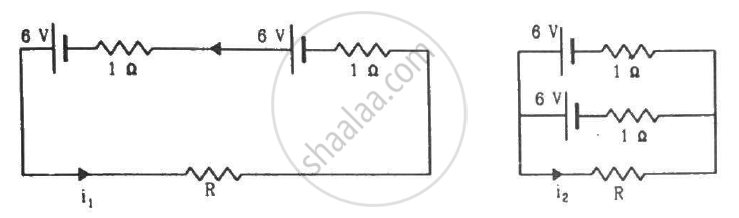
Find the value of i1/i2 in the following figure if (a) R = 0.1 Ω (b) R = 1 Ω and (c) R = 10 Ω. Note from your answers that in order to get more current from a combination of two batteries, they should be joined in parallel if the external resistance is small and in series if the external resistance is large, compared to the internal resistance.
How many time constants will elapse before the power delivered by a battery drops to half of its maximum value in an RC circuit?
A coil of resistance 100 Ω is connected across a battery of emf 6.0 V. Assume that the heat developed in the coil is used to raise its temperature. If the heat capacity of the coil is 4.0 J K−1, how long will it take to raise the temperature of the coil by 15°C?
Answer the following question.
A cell of emf E and internal resistance r is connected across a variable resistor R. Plot the shape of graphs showing a variation of terminal voltage V with (i) R and (ii) circuit current I.
A conductor of length ‘l’ is rotated about one of its ends at a constant angular speed ‘ω’ in a plane perpendicular to a uniform magnetic field B. Plot graphs to show variations of the emf induced across the ends of the conductor with
- angular speed ω and
- length of the conductor l.
If n cells each of emf e and internal resistance r are connected in parallel, then the total emf and internal resistance will be ______.
A straight line plot showing the terminal potential difference (V) of a cell as a function of current (I) drawn from it, is shown in the figure. The internal resistance of the cell would be then ______.

A cell E1 of emf 6 V and internal resistance 2 Ω is connected with another cell E2 of emf 4 V and internal resistance 8 Ω (as shown in the figure). The potential difference across points X and Y is ______.

Study the two circuits shown in the figure below. The cells in the two circuits are identical to each other. The resistance of the load resistor R is the same in both circuits.

If the same current flows through the resistor R in both circuits, calculate the internal resistance of each cell in terms of the resistance of resistor R. Show your calculations.
An electric cell is a device that converts which form of energy into electrical energy?
The emf of a cell is defined as the work done in carrying a unit positive charge through which part of the circuit?
What is the unit of EMF of a cell?
When current is drawn from or supplied to a cell, the potential difference across its terminals is called:
The relationship between terminal potential difference (V), EMF (ε), current (I), and internal resistance (r) is given by:
