Advertisements
Advertisements
प्रश्न
Two batteries of emf ε1 and ε2 (ε2 > ε1) and internal resistances r1 and r2 respectively are connected in parallel as shown in figure.

विकल्प
The equivalent emf εeq of the two cells is between ε1 and ε2, i.e. ε1 < εeq < ε2.
The equivalent emf εeq is smaller than ε1.
The εeq is given by εeq = ε1 + ε2 always.
εeq is independent of internal resistances r1 and r2.
Advertisements
उत्तर
The equivalent emf εeq of the two cells is between ε1 and ε2, i.e. ε1 < εeq < ε2.
Explanation:
The equivalent emf of this combination is given by
εeq = `(ε_1/r_1 + ε_1/r_2)/((1/r_1 + 1/r_2)) = (ε_1(1/r_1 + (ε_2/ε_1)/r_2))/((1/r_1 + 1/r_2)) = (ε_2((ε_1/ε_2)/r_1 + 1/r_2))/((1/r_1 + 1/r_2))`
As `ε_2/ε_1 > 1`
⇒ `((1/r_1 + (ε_2/r_1)/r_2))/((1/r_1 + 1/r_2)) > 1 or ε_(eq) > ε_1` also `ε_1/ε_2 < 1`
⇒ `(((ε_1/ε_2)/r_1 + 1/r_2))/((1/r_1 + 1/r_2)) < 1 or ε_(eq) < ε_1`
Hence ε1 < εeq < ε2.
APPEARS IN
संबंधित प्रश्न
Two cells of emfs 1.5 V and 2.0 V, having internal resistances 0.2 Ω and 0.3 Ω, respectively, are connected in parallel. Calculate the emf and internal resistance of the equivalent cell.
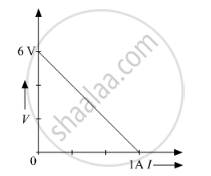
The plot of the variation of potential difference across a combination of three identical cells in series, versus current is shown below. What is the emf and internal resistance of each cell ?
Two identical cells of emf 1.5 V each joined in parallel, supply energy to an external circuit consisting of two resistances of 7 Ω each joined in parallel. A very high resistance voltmeter reads the terminal voltage of cells to be 1.4 V. Calculate the internal resistance of each cell.
A cell of emf 'E' and internal resistance 'r' is connected across a variable resistor 'R'. Plot a graph showing variation of terminal voltage 'V' of the cell versus the current 'I'. Using the plot, show how the emf of the cell and its internal resistance can be determined.
The storage battery of a car has an emf of 12 V. If the internal resistance of the battery is 0.4 Ω, what is the maximum current that can be drawn from the battery?
In a potentiometer arrangement, a cell of emf 1.25 V gives a balance point at 35.0 cm length of the wire. If the cell is replaced by another cell and the balance point shifts to 63.0 cm, what is the emf of the second cell?
In a potentiometer arrangement for determining the emf of a cell, the balance point of the cell in open circuit is 350 cm. When a resistance of 9 Ω is used in the external circuit of the cell, the balance point shifts to 300 cm. Determine the internal resistance of the cell.
Plot a graph showing variation of voltage vs the current drawn from the cell. How can one get information from this plot about the emf of the cell and its internal resistance?
A cell of emf ‘E’ and internal resistance ‘r’ draws a current ‘I’. Write the relation between terminal voltage ‘V’ in terms of E, I and r ?
A cell of emf ‘E’ and internal resistance ‘r’ is connected across a variable resistor ‘R’. Plot a graph showing the variation of terminal potential ‘V’ with resistance R. Predict from the graph the condition under which ‘V’ becomes equal to ‘E’.
Can the potential difference across a battery be greater than its emf?
A plate of area 10 cm2 is to be electroplated with copper (density 9000 kg m−3) to a thickness of 10 micrometres on both sides, using a cell of 12 V. Calculate the energy spent by the cell in the process of deposition. If this energy is used to heat 100 g of water, calculate the rise in the temperature of the water. ECE of copper = 3 × 10⁻⁷ kg C−1and specific heat capacity of water = 4200 J kg−1.
Answer the following question.
A cell of emf E and internal resistance r is connected across a variable resistor R. Plot the shape of graphs showing a variation of terminal voltage V with (i) R and (ii) circuit current I.
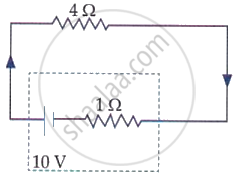
The terminal voltage of the battery, whose emf is 10 V and internal resistance 1 Ω, when connected through an external resistance of 4 Ω as shown in the figure is:
The emf of a cell is defined as the work done in carrying a unit positive charge through which part of the circuit?
What is the unit of EMF of a cell?
When a cell is short-circuited (R = 0), the maximum current that can flow is:
