Advertisements
Advertisements
प्रश्न
Two cells of emfs 1.5 V and 2.0 V, having internal resistances 0.2 Ω and 0.3 Ω, respectively, are connected in parallel. Calculate the emf and internal resistance of the equivalent cell.
Advertisements
उत्तर
Given:
E1=1.5 V
E2=2 V
r1=0.2 Ω
r2 =0.3 Ω
The effective emf of two cells connected in parallel can be calculated as follows:
`E_(eff) = (E_1r_2+E_2r_1)/(r_1+r_2)`
`=> E_(eff) = (1.5xx0.3+2.0xx0.2)/0.5 = 1.7 V`
The effective resistance can be calculated as follows:
`R_(eff)= (r_1r_2)/(r_1+r_2)`
`=> R_(eff)= (0.2xx.03)/0.5`= 0.12 Ω
संबंधित प्रश्न
The equivalent resistance between points. a and f of the network shown in Figure 2 is :
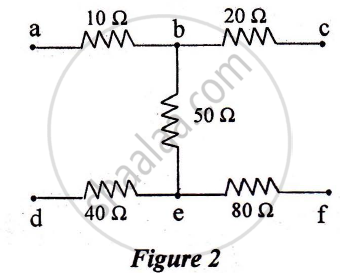
a) 24 Ω
b) 110 Ω
c) 140 Ω
d) 200 Ω
Plot a graph showing variation of voltage vs the current drawn from the cell. How can one get information from this plot about the emf of the cell and its internal resistance?
A rectangular conductor LMNO is placed in a uniform magnetic field of 0.5 T. The field is directed perpendicular to the plane of the conductor. When the arm MN of length of 20 cm is moved towards left with a velocity of 10 ms−1, calculate the emf induced in the arm. Given the resistance of the arm to be 5 Ω (assuming that other arms are of negligible resistance) find the value of the current in the arm.

A cell of emf E and internal resistance r is connected to two external resistance R1 and R2 and a perfect ammeter. The current in the circuit is measured in four different situations:
(i) without any external resistance in the circuit
(ii) with resistance R1 only
(iii) with R1 and R2 in series combination
(iv) with R1 and R2 in parallel combination
The currents measured in the four cases are 0.42 A, 1.05 A, 1.4 A and 4.2 A, but not necessarily in the order. Identify the currents corresponding to the four cases mentioned above.
A cell of emf ‘E’ and internal resistance ‘r’ is connected across a variable resistor ‘R’. Plot a graph showing the variation of terminal potential ‘V’ with resistance R. Predict from the graph the condition under which ‘V’ becomes equal to ‘E’.
A battery of emf 100 V and a resistor of resistance 10 kΩ are joined in series. This system is used as a source to supply current to an external resistance R. If R is not greater than 100 Ω, the current through it is constant up to two significant digits.
Find its value. This is the basic principle of a constant-current source.
Find the equivalent resistance of the network shown in the figure between the points a and b.
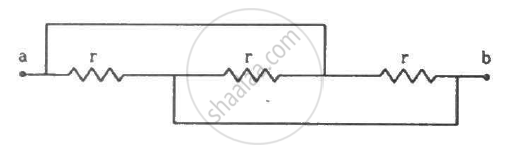
Internal resistance of a cell is the resistance offered by which component?
During charging of a cell, the terminal potential difference formula is:
During charging, electrical energy is converted to:
