Advertisements
Advertisements
प्रश्न
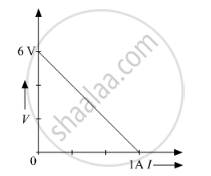
The plot of the variation of potential difference across a combination of three identical cells in series, versus current is shown below. What is the emf and internal resistance of each cell ?
Advertisements
उत्तर १
Let E and r be the EMF and internal resistance of all cells respectively and e and r' be the EMF and internal resistance of each cell respectively.
As we know,
According to the definition of the terminal potential difference,
V = E − Ir
E is the EMF and r is the total internal resistance of the circuit.
I = 0 ⇒ V = E
From the graph we can see
E = 6 V
As there are three cells we can write,
E = 3 × e ⇒ e = 2 V
And, when, V = 0
⇒ E = Ir
`r=E/T=6/1=6Omega`
As per the question the cells are connected in the series, so we can write.
`r'=r/3=2Omega`
उत्तर २
Since there are three cells connected in series, Total EMF = E1 + E2 + E3
We can observe from the graph that,
E1 + E2 + E3 = 6
3E = 6 (E = E1 = E2 = E3, as they are identical cells)
hence, The EMF of each cell is 2Volt.
Now, similarly, the internal resistance is also 2 Ohm for each, because in series combination of cells not only the Emf the internal resistance also gets added up.
APPEARS IN
संबंधित प्रश्न
Two cells of emfs 1.5 V and 2.0 V, having internal resistances 0.2 Ω and 0.3 Ω, respectively, are connected in parallel. Calculate the emf and internal resistance of the equivalent cell.
Two identical cells of emf 1.5 V each joined in parallel, supply energy to an external circuit consisting of two resistances of 7 Ω each joined in parallel. A very high resistance voltmeter reads the terminal voltage of cells to be 1.4 V. Calculate the internal resistance of each cell.
A long straight current carrying wire passes normally through the centre of circular loop. If the current through the wire increases, will there be an induced emf in the loop? Justify.
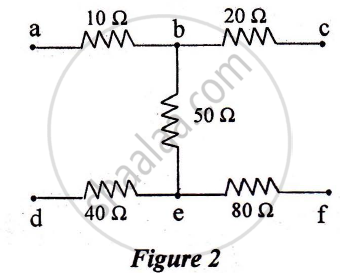
The equivalent resistance between points. a and f of the network shown in Figure 2 is :
a) 24 Ω
b) 110 Ω
c) 140 Ω
d) 200 Ω
Apply the first law of thermodynamics to a resistor carrying a current i. Identify which of the quantities ∆Q, ∆U and ∆W are zero, positive and negative.
Do the electrodes in an electrolytic cell have fixed polarity like a battery?
A coil of resistance 100 Ω is connected across a battery of emf 6.0 V. Assume that the heat developed in the coil is used to raise its temperature. If the heat capacity of the coil is 4.0 J K−1, how long will it take to raise the temperature of the coil by 15°C?
The temperatures of the junctions of a bismuth-silver thermocouple are maintained at 0°C and 0.001°C. Find the thermo-emf (Seebeck emf) developed. For bismuth-silver, a = − 46 × 10−6 V°C−1 and b = −0.48 × 10⁻⁶ V°C−2.
The relationship between terminal potential difference (V), EMF (ε), current (I), and internal resistance (r) is given by:
Internal resistance of a cell increases when the distance between electrodes:
