Advertisements
Advertisements
प्रश्न
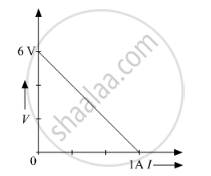
The plot of the variation of potential difference across a combination of three identical cells in series, versus current is shown below. What is the emf and internal resistance of each cell ?
Advertisements
उत्तर १
Let E and r be the EMF and internal resistance of all cells respectively and e and r' be the EMF and internal resistance of each cell respectively.
As we know,
According to the definition of the terminal potential difference,
V = E − Ir
E is the EMF and r is the total internal resistance of the circuit.
I = 0 ⇒ V = E
From the graph we can see
E = 6 V
As there are three cells we can write,
E = 3 × e ⇒ e = 2 V
And, when, V = 0
⇒ E = Ir
`r=E/T=6/1=6Omega`
As per the question the cells are connected in the series, so we can write.
`r'=r/3=2Omega`
उत्तर २
Since there are three cells connected in series, Total EMF = E1 + E2 + E3
We can observe from the graph that,
E1 + E2 + E3 = 6
3E = 6 (E = E1 = E2 = E3, as they are identical cells)
hence, The EMF of each cell is 2Volt.
Now, similarly, the internal resistance is also 2 Ohm for each, because in series combination of cells not only the Emf the internal resistance also gets added up.
APPEARS IN
संबंधित प्रश्न
A cell of emf E and internal resistance r is connected to two external resistance R1 and R2 and a perfect ammeter. The current in the circuit is measured in four different situations:
(i) without any external resistance in the circuit
(ii) with resistance R1 only
(iii) with R1 and R2 in series combination
(iv) with R1 and R2 in parallel combination
The currents measured in the four cases are 0.42 A, 1.05 A, 1.4 A and 4.2 A, but not necessarily in the order. Identify the currents corresponding to the four cases mentioned above.
A cell of emf ‘E’ and internal resistance ‘r’ is connected across a variable resistor ‘R’. Plot a graph showing the variation of terminal potential ‘V’ with resistance R. Predict from the graph the condition under which ‘V’ becomes equal to ‘E’.
Two non-ideal batteries are connected in series. Consider the following statements:-
(A) The equivalent emf is larger than either of the two emfs.
(B) The equivalent internal resistance is smaller than either of the two internal resistances.
How many time constants will elapse before the power delivered by a battery drops to half of its maximum value in an RC circuit?
A plate of area 10 cm2 is to be electroplated with copper (density 9000 kg m−3) to a thickness of 10 micrometres on both sides, using a cell of 12 V. Calculate the energy spent by the cell in the process of deposition. If this energy is used to heat 100 g of water, calculate the rise in the temperature of the water. ECE of copper = 3 × 10⁻⁷ kg C−1and specific heat capacity of water = 4200 J kg−1.
The emf of a cell is defined as the work done in carrying a unit positive charge through which part of the circuit?
The relationship between terminal potential difference (V), EMF (ε), current (I), and internal resistance (r) is given by:
During discharging of a cell, the current direction flows out of:
During charging of a cell, how does terminal voltage (V) compare to EMF (ε)?
