Advertisements
Advertisements
प्रश्न
Nichrome and copper wires of same length and same radius are connected in series. Current I is passed through them. Which wire gets heated up more? Justify your answer.
Advertisements
उत्तर
Nichrome wire gets heated up more.
We know that nichrome is an alloy whereas copper is a metal and it is known that the resistivity of alloy is greater than the resistivity of metal. This means that resistance of nichrome wire (Rn) is greater than the resistance of copper wire ( Rc)
Also, we know that heat generated (H) across a resistor is given by the expression
H =IRt
or,
H ∝ R
So more the resistance of a wire, more will be heat generated in it.
Hence, we can say nichrome wire gets more heated up as compared to the copper wire.
संबंधित प्रश्न
In a potentiometer arrangement for determining the emf of a cell, the balance point of the cell in open circuit is 350 cm. When a resistance of 9 Ω is used in the external circuit of the cell, the balance point shifts to 300 cm. Determine the internal resistance of the cell.
Two identical cells, each of emf E, having negligible internal resistance, are connected in parallel with each other across an external resistance R. What is the current through this resistance?
A rectangular conductor LMNO is placed in a uniform magnetic field of 0.5 T. The field is directed perpendicular to the plane of the conductor. When the arm MN of length of 20 cm is moved towards left with a velocity of 10 ms−1, calculate the emf induced in the arm. Given the resistance of the arm to be 5 Ω (assuming that other arms are of negligible resistance) find the value of the current in the arm.

Two cells of emf E1, E2 and internal resistance r1 and r2 respectively are connected in parallel as shown in the figure.
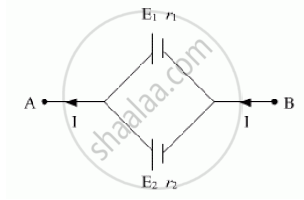
Deduce the expressions for
(1) the equivalent e.m.f of the combination
(2) the equivalent resistance of the combination, and
(3) the potential difference between the point A and B.
Consider N = n1n2 identical cells, each of emf ε and internal resistance r. Suppose n1 cells are joined in series to form a line and n2 such lines are connected in parallel.
The combination drives a current in an external resistance R. (a) Find the current in the external resistance. (b) Assuming that n1 and n2 can be continuously varied, find the relation between n1, n2, R and r for which the current in R is maximum.
An ac generator generates an emf which is given by e = 311 sin (240 πt) V. Calculate:
- frequency of the emf.
- r.m.s. value of the emf.
Internal resistance of a cell is the resistance offered by which component?
When current is drawn from or supplied to a cell, the potential difference across its terminals is called:
When a cell is short-circuited (R = 0), the maximum current that can flow is:
During charging of a cell, the terminal potential difference formula is:
