Advertisements
Advertisements
प्रश्न
Answer the following question.
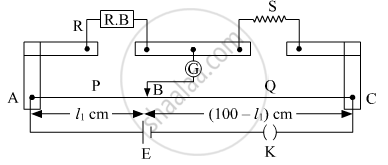
What is the end error in a meter bridge? How is it overcome? The resistances in the two arms of the metre bridge are R = Ω and S respectively. When the resistance S is shunted with equal resistance, the new balance length found to be 1.5 l1, where l2 is the initial balancing length. calculate the value of s.
Advertisements
उत्तर
The shifting of zero of the scale at different points as well as the stray resistance gives rise to the end error in meter bridge wire. This error arises due to the non-uniformity of the meter wire End corrections can be estimated by including known resistances P1 and Q1 in the two ends and finding the null point.
We have
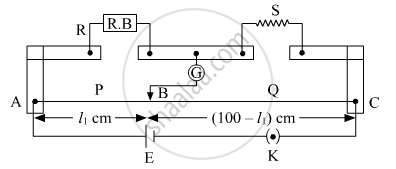
R = 5 Ω
According to wheat stone bridge principle:
`R/l_1 = S/(100 - l_1)`
`5/l_1 = S/(100 - l_1)` ....(1)
After shunting, connect the resistance in parallel
`S → S/2`
`5/(1.5 l_1) = S/(2(100 - 1.5 l_1))` ....(2)
Thus, equation (1) can be written as
`500 - 5l_1 = Sl_1` ....(3)
And equation 2 is
`10(100 - 1.5l_1) = 1.5 Sl_1` ....(4)
From equation (3) and (4)
`(500 - 5l_1)/l_1 = (1000 - 15l_1)/(1.5l_1)`
`750 - 7.5l_1 = 1000 - 15l_1`
`-250 = -7.5l_1`
`l_1 = 100/3`
S = `(500 - (5 xx 100)/3)/(100/3) = (500 - 500/3)/(100/3) = 1000/3 xx 3/100`
S = 10 Ω
संबंधित प्रश्न
In a potentiometer arrangement for determining the emf of a cell, the balance point of the cell in open circuit is 350 cm. When a resistance of 9 Ω is used in the external circuit of the cell, the balance point shifts to 300 cm. Determine the internal resistance of the cell.
A cell of emf ‘E’ and internal resistance ‘r’ draws a current ‘I’. Write the relation between terminal voltage ‘V’ in terms of E, I and r ?
Two identical cells, each of emf E, having negligible internal resistance, are connected in parallel with each other across an external resistance R. What is the current through this resistance?
A cell of emf E and internal resistance r is connected to two external resistance R1 and R2 and a perfect ammeter. The current in the circuit is measured in four different situations:
(i) without any external resistance in the circuit
(ii) with resistance R1 only
(iii) with R1 and R2 in series combination
(iv) with R1 and R2 in parallel combination
The currents measured in the four cases are 0.42 A, 1.05 A, 1.4 A and 4.2 A, but not necessarily in the order. Identify the currents corresponding to the four cases mentioned above.
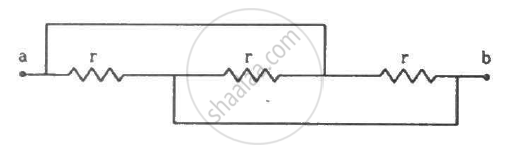
Find the equivalent resistance of the network shown in the figure between the points a and b.
A straight line plot showing the terminal potential difference (V) of a cell as a function of current (I) drawn from it, is shown in the figure. The internal resistance of the cell would be then ______.

An ac generator generates an emf which is given by e = 311 sin (240 πt) V. Calculate:
- frequency of the emf.
- r.m.s. value of the emf.
The relationship between terminal potential difference (V), EMF (ε), current (I), and internal resistance (r) is given by:
When a cell is short-circuited (R = 0), the maximum current that can flow is:
During discharging, chemical energy is converted to:
