Advertisements
Advertisements
प्रश्न
Answer the following question.
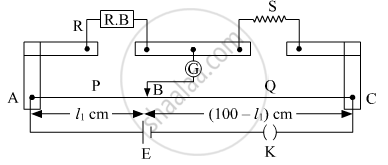
What is the end error in a meter bridge? How is it overcome? The resistances in the two arms of the metre bridge are R = Ω and S respectively. When the resistance S is shunted with equal resistance, the new balance length found to be 1.5 l1, where l2 is the initial balancing length. calculate the value of s.
Advertisements
उत्तर
The shifting of zero of the scale at different points as well as the stray resistance gives rise to the end error in meter bridge wire. This error arises due to the non-uniformity of the meter wire End corrections can be estimated by including known resistances P1 and Q1 in the two ends and finding the null point.
We have
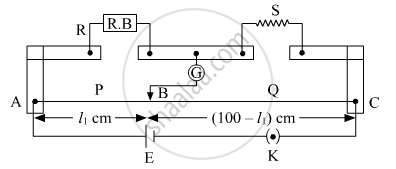
R = 5 Ω
According to wheat stone bridge principle:
`R/l_1 = S/(100 - l_1)`
`5/l_1 = S/(100 - l_1)` ....(1)
After shunting, connect the resistance in parallel
`S → S/2`
`5/(1.5 l_1) = S/(2(100 - 1.5 l_1))` ....(2)
Thus, equation (1) can be written as
`500 - 5l_1 = Sl_1` ....(3)
And equation 2 is
`10(100 - 1.5l_1) = 1.5 Sl_1` ....(4)
From equation (3) and (4)
`(500 - 5l_1)/l_1 = (1000 - 15l_1)/(1.5l_1)`
`750 - 7.5l_1 = 1000 - 15l_1`
`-250 = -7.5l_1`
`l_1 = 100/3`
S = `(500 - (5 xx 100)/3)/(100/3) = (500 - 500/3)/(100/3) = 1000/3 xx 3/100`
S = 10 Ω
संबंधित प्रश्न
In a potentiometer arrangement, a cell of emf 1.25 V gives a balance point at 35.0 cm length of the wire. If the cell is replaced by another cell and the balance point shifts to 63.0 cm, what is the emf of the second cell?
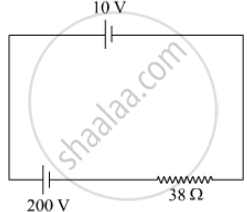
A 10 V cell of negligible internal resistance is connected in parallel across a battery of emf 200 V and internal resistance 38 Ω as shown in the figure. Find the value of current in the circuit.
A cell of emf ‘E’ and internal resistance ‘r’ is connected across a variable resistor ‘R’. Plot a graph showing the variation of terminal potential ‘V’ with resistance R. Predict from the graph the condition under which ‘V’ becomes equal to ‘E’.
Two non-ideal batteries are connected in series. Consider the following statements:-
(A) The equivalent emf is larger than either of the two emfs.
(B) The equivalent internal resistance is smaller than either of the two internal resistances.
A battery of emf 100 V and a resistor of resistance 10 kΩ are joined in series. This system is used as a source to supply current to an external resistance R. If R is not greater than 100 Ω, the current through it is constant up to two significant digits.
Find its value. This is the basic principle of a constant-current source.
Two cells of emfs approximately 5 V and 10 V are to be accurately compared using a potentiometer of length 400 cm.
A cell of emf E and internal resistance r is connected across an external resistance R. Plot a graph showing the variation of P.D. across R, versus R.
A cell of emf E is connected across an external resistance R. When current 'I' is drawn from the cell, the potential difference across the electrodes of the cell drops to V. The internal resistance 'r' of the cell is ______.
Study the two circuits shown in the figure below. The cells in the two circuits are identical to each other. The resistance of the load resistor R is the same in both circuits.

If the same current flows through the resistor R in both circuits, calculate the internal resistance of each cell in terms of the resistance of resistor R. Show your calculations.
Internal resistance of a cell is affected by the surface area of electrodes. As surface area increases, internal resistance:
