Advertisements
Advertisements
प्रश्न
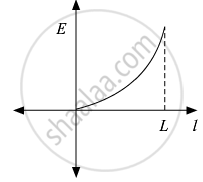
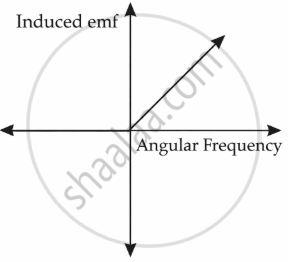
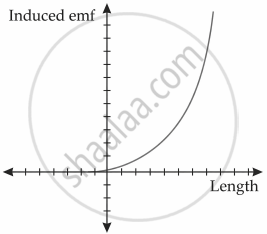
A conductor of length ‘l’ is rotated about one of its ends at a constant angular speed ‘ω’ in a plane perpendicular to a uniform magnetic field B. Plot graphs to show variations of the emf induced across the ends of the conductor with
- angular speed ω and
- length of the conductor l.
Advertisements
उत्तर १
Induced emf (E) = `(B omega l^2)/2`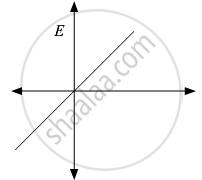
उत्तर २
i. e = `1/2 B omega L^2`
So, e ∝ ω
ii. e = `1/2 B omega L^2`
So, e ∝ L2
संबंधित प्रश्न
Two cells of emfs 1.5 V and 2.0 V, having internal resistances 0.2 Ω and 0.3 Ω, respectively, are connected in parallel. Calculate the emf and internal resistance of the equivalent cell.
Consider N = n1n2 identical cells, each of emf ε and internal resistance r. Suppose n1 cells are joined in series to form a line and n2 such lines are connected in parallel.
The combination drives a current in an external resistance R. (a) Find the current in the external resistance. (b) Assuming that n1 and n2 can be continuously varied, find the relation between n1, n2, R and r for which the current in R is maximum.
The temperatures of the junctions of a bismuth-silver thermocouple are maintained at 0°C and 0.001°C. Find the thermo-emf (Seebeck emf) developed. For bismuth-silver, a = − 46 × 10−6 V°C−1 and b = −0.48 × 10⁻⁶ V°C−2.
Answer the following question.
A cell of emf E and internal resistance r is connected across a variable resistor R. Plot the shape of graphs showing a variation of terminal voltage V with (i) R and (ii) circuit current I.
The internal resistance of a cell is the resistance of ______
An electric cell is a device that converts which form of energy into electrical energy?
During discharging of a cell, the current direction flows out of:
During discharging, chemical energy is converted to:
During charging, electrical energy is converted to:
