Advertisements
Advertisements
प्रश्न
Answer the following question.
A cell of emf E and internal resistance r is connected across a variable resistor R. Plot the shape of graphs showing a variation of terminal voltage V with (i) R and (ii) circuit current I.
A cell emf of (E) and internal resistance. (r) is connected across a variable load resistance (R). Draw plots showing the variation of terminal voltage V with (i) R and (ii) the current (I) in the load.
Advertisements
उत्तर
Terminal Voltage V can be related to R by the following relation:
(i) `V = (ER)/(R+r)`
⇒ `V = (E)/(1+r/R)`
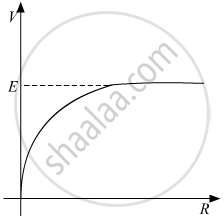
(ii) Terminal Voltage V can be related to I by the following relation:
V = E - IR
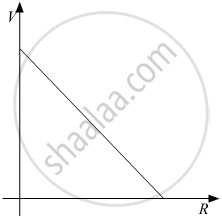
APPEARS IN
संबंधित प्रश्न
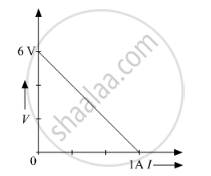
The plot of the variation of potential difference across a combination of three identical cells in series, versus current is shown below. What is the emf and internal resistance of each cell ?
Two identical cells of emf 1.5 V each joined in parallel, supply energy to an external circuit consisting of two resistances of 7 Ω each joined in parallel. A very high resistance voltmeter reads the terminal voltage of cells to be 1.4 V. Calculate the internal resistance of each cell.
A plate of area 10 cm2 is to be electroplated with copper (density 9000 kg m−3) to a thickness of 10 micrometres on both sides, using a cell of 12 V. Calculate the energy spent by the cell in the process of deposition. If this energy is used to heat 100 g of water, calculate the rise in the temperature of the water. ECE of copper = 3 × 10⁻⁷ kg C−1and specific heat capacity of water = 4200 J kg−1.
Answer the following question.
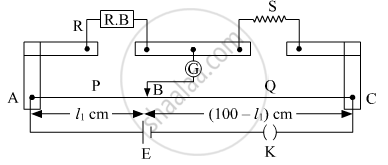
What is the end error in a meter bridge? How is it overcome? The resistances in the two arms of the metre bridge are R = Ω and S respectively. When the resistance S is shunted with equal resistance, the new balance length found to be 1.5 l1, where l2 is the initial balancing length. calculate the value of s.
An ac generator generates an emf which is given by e = 311 sin (240 πt) V. Calculate:
- frequency of the emf.
- r.m.s. value of the emf.
Study the two circuits shown in the figure below. The cells in the two circuits are identical to each other. The resistance of the load resistor R is the same in both circuits.

If the same current flows through the resistor R in both circuits, calculate the internal resistance of each cell in terms of the resistance of resistor R. Show your calculations.
During discharging of a cell, how does terminal voltage (V) compare to EMF (ε)?
Internal resistance of a cell increases when the distance between electrodes:
Internal resistance of a cell is affected by the surface area of electrodes. As surface area increases, internal resistance:
