Advertisements
Advertisements
प्रश्न
A plate of area 10 cm2 is to be electroplated with copper (density 9000 kg m−3) to a thickness of 10 micrometres on both sides, using a cell of 12 V. Calculate the energy spent by the cell in the process of deposition. If this energy is used to heat 100 g of water, calculate the rise in the temperature of the water. ECE of copper = 3 × 10⁻⁷ kg C−1and specific heat capacity of water = 4200 J kg−1.
Advertisements
उत्तर
Surface area of the plate, A = 10 cm2 = 10 × 10−4 m2
Thickness of copper deposited, t = 10 μm = 10−5 m
Density of copper = 9000 kg/m3
Volume of copper deposited, V = A(2t)
V = 10 × 10−4 × 2 × 10 × 10−6
= 2 × 102 × 10−10
= 2 × 10⁻⁸ m3
Mass of copper deposited, m = Volume × Density = 2 × 10−8 × 9000
⇒ m = 18 × 10−5 kg
Using the formula, m = ZQ, we get:-
18 × 10−5 = 3 × 10⁻⁷ × Q
⇒ Q = 6 × 10² C
Energy spent by the cell = Work done by the cell
⇒W = VQ
= 12 × 6 × 102
= 72 × 102 = 7.2 kJ
Let ∆θ be the rise in temperature of water. When this energy is used to heat 100 g of water, we have:-
7.2 × 103 = 100 × 10−3 × 4200 × ∆θ
⇒ ∆θ = 17 K
APPEARS IN
संबंधित प्रश्न
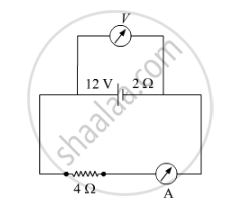
A battery of emf 12 V and internal resistance 2 Ω is connected to a 4 Ω resistor as shown in the figure.
(a) Show that a voltmeter when placed across the cell and across the resistor, in turn, gives the same reading.
(b) To record the voltage and the current in the circuit, why is voltmeter placed in parallel and ammeter in series in the circuit?
A secondary cell after long use has an emf of 1.9 V and a large internal resistance of 380 Ω. What maximum current can be drawn from the cell? Could the cell drive the starting motor of a car?
A long straight current carrying wire passes normally through the centre of circular loop. If the current through the wire increases, will there be an induced emf in the loop? Justify.
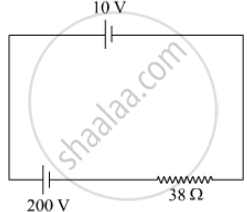
A 10 V cell of negligible internal resistance is connected in parallel across a battery of emf 200 V and internal resistance 38 Ω as shown in the figure. Find the value of current in the circuit.
Two identical cells, each of emf E, having negligible internal resistance, are connected in parallel with each other across an external resistance R. What is the current through this resistance?
Two non-ideal batteries are connected in series. Consider the following statements:-
(A) The equivalent emf is larger than either of the two emfs.
(B) The equivalent internal resistance is smaller than either of the two internal resistances.
Do all thermocouples have a neutral temperature?
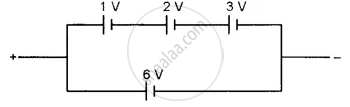
Find the emf of the battery shown in the figure:
Answer the following question.
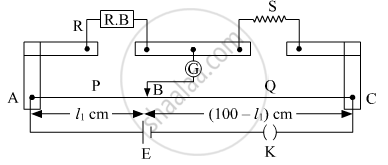
What is the end error in a meter bridge? How is it overcome? The resistances in the two arms of the metre bridge are R = Ω and S respectively. When the resistance S is shunted with equal resistance, the new balance length found to be 1.5 l1, where l2 is the initial balancing length. calculate the value of s.
A conductor of length ‘l’ is rotated about one of its ends at a constant angular speed ‘ω’ in a plane perpendicular to a uniform magnetic field B. Plot graphs to show variations of the emf induced across the ends of the conductor with
- angular speed ω and
- length of the conductor l.
If n cells each of emf e and internal resistance r are connected in parallel, then the total emf and internal resistance will be ______.
A battery of EMF 10V sets up a current of 1A when connected across a resistor of 8Ω. If the resistor is shunted by another 8Ω resistor, what would be the current in the circuit? (in A)
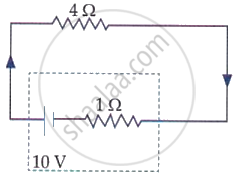
The terminal voltage of the battery, whose emf is 10 V and internal resistance 1 Ω, when connected through an external resistance of 4 Ω as shown in the figure is:
During charging of a cell, the current direction enters through:
During charging of a cell, the terminal potential difference formula is:
During charging of a cell, how does terminal voltage (V) compare to EMF (ε)?
Internal resistance of a cell is affected by the surface area of electrodes. As surface area increases, internal resistance:
