Advertisements
Advertisements
प्रश्न
In a potentiometer arrangement, a cell of emf 1.25 V gives a balance point at 35.0 cm length of the wire. If the cell is replaced by another cell and the balance point shifts to 63.0 cm, what is the emf of the second cell?
In a potentiometer experiment, a cell of emf 1.25 V gives a balance point at 35 cm mark of the wire. If this cell is replaced by another cell, the balance point is at 63 cm mark. Calculate the emf of the second cell.
Advertisements
उत्तर
Emf of the cell, E1 = 1.25 V
Balance point of the potentiometer, l1 = 35 cm
The cell is replaced by another cell of emf E2.
New balance point of the potentiometer, l2 = 63 cm
The balance condition is given by the relation,
`E_1/E_2 = I_1/I_2`
`E_2 = E_1 xx I_2/I_1`
= `1.25 xx 63/35`
= 2.25 V
Therefore, the emf of the second cell is 2.25 V.
संबंधित प्रश्न
The storage battery of a car has an emf of 12 V. If the internal resistance of the battery is 0.4 Ω, what is the maximum current that can be drawn from the battery?
A storage battery of emf 8.0 V and internal resistance 0.5 Ω is being charged by a 120 V dc supply using a series resistor of 15.5 Ω. What is the terminal voltage of the battery during charging? What is the purpose of having a series resistor in the charging circuit?
A long straight current carrying wire passes normally through the centre of circular loop. If the current through the wire increases, will there be an induced emf in the loop? Justify.
A resistor R is connected to a cell of-emf e and internal resistance r. The potential difference across the resistor R is found to be V. State the relation between e, V, Rand r.
Can the potential difference across a battery be greater than its emf?
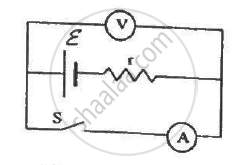
The following figure shows an arrangement to measure the emf ε and internal resistance r of a battery. The voltmeter has a very high resistance and the ammeter also has some resistance. The voltmeter reads 1.52 V when the switch S is open. When the switch is closed, the voltmeter reading drops to 1.45 V and the ammeter reads 1.0 A. Find the emf and the internal resistance of the battery.
Apply the first law of thermodynamics to a resistor carrying a current i. Identify which of the quantities ∆Q, ∆U and ∆W are zero, positive and negative.
Do all thermocouples have a neutral temperature?
If n cells each of emf e and internal resistance r are connected in parallel, then the total emf and internal resistance will be ______.
A straight line plot showing the terminal potential difference (V) of a cell as a function of current (I) drawn from it, is shown in the figure. The internal resistance of the cell would be then ______.

A cell E1 of emf 6 V and internal resistance 2 Ω is connected with another cell E2 of emf 4 V and internal resistance 8 Ω (as shown in the figure). The potential difference across points X and Y is ______.

The emf of a cell is defined as the work done in carrying a unit positive charge through which part of the circuit?
When current is drawn from or supplied to a cell, the potential difference across its terminals is called:
When a cell is short-circuited (R = 0), the maximum current that can flow is:
During charging of a cell, the current direction enters through:
During charging, electrical energy is converted to:
Internal resistance of a cell is affected by the surface area of electrodes. As surface area increases, internal resistance:
