Advertisements
Advertisements
प्रश्न
A coil of resistance 100 Ω is connected across a battery of emf 6.0 V. Assume that the heat developed in the coil is used to raise its temperature. If the heat capacity of the coil is 4.0 J K−1, how long will it take to raise the temperature of the coil by 15°C?
Advertisements
उत्तर
Given:-
Resistance of the coil, R = 100 Ω,
Emf of the battery, V = 6 V,
Change in temperature, ∆T = 15°C
Heat produced across the coil,
\[H = \frac{V^2}{R}t\]
This heat produced is used to increase the temperature of the coil.
\[\Rightarrow H = c ∆ T\]
\[ \Rightarrow \frac{V^2}{R}t = c ∆ T\]
\[ \Rightarrow \frac{36}{100}t = 4 \times 15\]
\[ \Rightarrow t = \frac{6000}{36} = 166 . 7 s = 2 . 8 \min\]
APPEARS IN
संबंधित प्रश्न
Distinguish between emf and terminal voltage of a cell.
A storage battery of emf 8.0 V and internal resistance 0.5 Ω is being charged by a 120 V dc supply using a series resistor of 15.5 Ω. What is the terminal voltage of the battery during charging? What is the purpose of having a series resistor in the charging circuit?
Nichrome and copper wires of same length and same radius are connected in series. Current I is passed through them. Which wire gets heated up more? Justify your answer.
A long straight current carrying wire passes normally through the centre of circular loop. If the current through the wire increases, will there be an induced emf in the loop? Justify.
Two identical cells, each of emf E, having negligible internal resistance, are connected in parallel with each other across an external resistance R. What is the current through this resistance?
Two cells of emf E1, E2 and internal resistance r1 and r2 respectively are connected in parallel as shown in the figure.
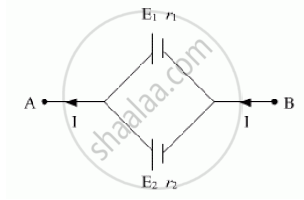
Deduce the expressions for
(1) the equivalent e.m.f of the combination
(2) the equivalent resistance of the combination, and
(3) the potential difference between the point A and B.
Consider N = n1n2 identical cells, each of emf ε and internal resistance r. Suppose n1 cells are joined in series to form a line and n2 such lines are connected in parallel.
The combination drives a current in an external resistance R. (a) Find the current in the external resistance. (b) Assuming that n1 and n2 can be continuously varied, find the relation between n1, n2, R and r for which the current in R is maximum.
A battery of emf 100 V and a resistor of resistance 10 kΩ are joined in series. This system is used as a source to supply current to an external resistance R. If R is not greater than 100 Ω, the current through it is constant up to two significant digits.
Find its value. This is the basic principle of a constant-current source.
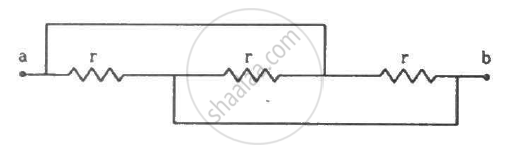
Find the equivalent resistance of the network shown in the figure between the points a and b.
Do all thermocouples have a neutral temperature?
The internal resistance of a cell is the resistance of ______
A cell of emf E and internal resistance r is connected across an external resistance R. Plot a graph showing the variation of P.D. across R, versus R.
What is the unit of EMF of a cell?
When current is drawn from or supplied to a cell, the potential difference across its terminals is called:
The relationship between terminal potential difference (V), EMF (ε), current (I), and internal resistance (r) is given by:
During charging of a cell, the current direction enters through:
During charging of a cell, the terminal potential difference formula is:
During charging of a cell, how does terminal voltage (V) compare to EMF (ε)?
