Advertisements
Advertisements
प्रश्न
Nichrome and copper wires of same length and same radius are connected in series. Current I is passed through them. Which wire gets heated up more? Justify your answer.
Advertisements
उत्तर
Nichrome wire gets heated up more.
We know that nichrome is an alloy whereas copper is a metal and it is known that the resistivity of alloy is greater than the resistivity of metal. This means that resistance of nichrome wire (Rn) is greater than the resistance of copper wire ( Rc)
Also, we know that heat generated (H) across a resistor is given by the expression
H =IRt
or,
H ∝ R
So more the resistance of a wire, more will be heat generated in it.
Hence, we can say nichrome wire gets more heated up as compared to the copper wire.
संबंधित प्रश्न
The storage battery of a car has an emf of 12 V. If the internal resistance of the battery is 0.4 Ω, what is the maximum current that can be drawn from the battery?
A resistor R is connected to a cell of-emf e and internal resistance r. The potential difference across the resistor R is found to be V. State the relation between e, V, Rand r.
Two non-ideal batteries are connected in series. Consider the following statements:-
(A) The equivalent emf is larger than either of the two emfs.
(B) The equivalent internal resistance is smaller than either of the two internal resistances.
Apply the first law of thermodynamics to a resistor carrying a current i. Identify which of the quantities ∆Q, ∆U and ∆W are zero, positive and negative.
The temperatures of the junctions of a bismuth-silver thermocouple are maintained at 0°C and 0.001°C. Find the thermo-emf (Seebeck emf) developed. For bismuth-silver, a = − 46 × 10−6 V°C−1 and b = −0.48 × 10⁻⁶ V°C−2.
Five cells each of emf E and internal resistance r send the same amount of current through an external resistance R whether the cells are connected in parallel or in series. Then the ratio `("R"/"r")` is:
Two batteries of emf ε1 and ε2 (ε2 > ε1) and internal resistances r1 and r2 respectively are connected in parallel as shown in figure.

The terminal voltage of the battery, whose emf is 10 V and internal resistance 1 Ω, when connected through an external resistance of 4 Ω as shown in the figure is:
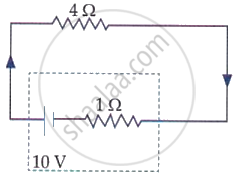
The relationship between terminal potential difference (V), EMF (ε), current (I), and internal resistance (r) is given by:
Internal resistance of a cell is affected by the surface area of electrodes. As surface area increases, internal resistance:
