Advertisements
Advertisements
Question
Nichrome and copper wires of same length and same radius are connected in series. Current I is passed through them. Which wire gets heated up more? Justify your answer.
Advertisements
Solution
Nichrome wire gets heated up more.
We know that nichrome is an alloy whereas copper is a metal and it is known that the resistivity of alloy is greater than the resistivity of metal. This means that resistance of nichrome wire (Rn) is greater than the resistance of copper wire ( Rc)
Also, we know that heat generated (H) across a resistor is given by the expression
H =IRt
or,
H ∝ R
So more the resistance of a wire, more will be heat generated in it.
Hence, we can say nichrome wire gets more heated up as compared to the copper wire.
RELATED QUESTIONS
The equivalent resistance between points. a and f of the network shown in Figure 2 is :
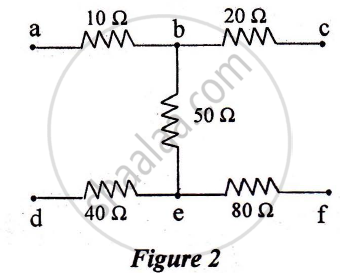
a) 24 Ω
b) 110 Ω
c) 140 Ω
d) 200 Ω
A cell of emf ‘E’ and internal resistance ‘r’ is connected across a variable resistor ‘R’. Plot a graph showing the variation of terminal potential ‘V’ with resistance R. Predict from the graph the condition under which ‘V’ becomes equal to ‘E’.
The temperatures of the junctions of a bismuth-silver thermocouple are maintained at 0°C and 0.001°C. Find the thermo-emf (Seebeck emf) developed. For bismuth-silver, a = − 46 × 10−6 V°C−1 and b = −0.48 × 10⁻⁶ V°C−2.
Answer the following question.
A cell of emf E and internal resistance r is connected across a variable resistor R. Plot the shape of graphs showing a variation of terminal voltage V with (i) R and (ii) circuit current I.
A cell having an emf E and internal resistance r is connected across a variable external resistance R. As the resistance R is increased, the plot of potential difference V across R is given by ______.
The emf of a cell is defined as the work done in carrying a unit positive charge through which part of the circuit?
What is the unit of EMF of a cell?
When current is drawn from or supplied to a cell, the potential difference across its terminals is called:
During discharging of a cell, the current direction flows out of:
During discharging, chemical energy is converted to:
