Advertisements
Advertisements
प्रश्न
Two cells of emf E1, E2 and internal resistance r1 and r2 respectively are connected in parallel as shown in the figure.
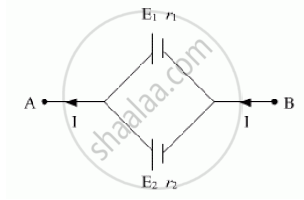
Deduce the expressions for
(1) the equivalent e.m.f of the combination
(2) the equivalent resistance of the combination, and
(3) the potential difference between the point A and B.
Advertisements
उत्तर

Let I1 and I2 be the current in two cells with emf E1 and E2 and internal resistance r1 and r2
So I = I1 + I2
Now let V be the potential difference between the points A and B. Since the first cell is connected between the points A and B.
V = potential difference across first cell
V = E1 − I1r1
`or I_1 =(E_1-V)/r_1`
Now, the second cell is also connected between the points A and B. So,
`or I_2 =(E_2-V)/r_2`
Thus, substituting for I1 and I2
`I =(E_1-V)/r_1 + (E_2-V)/r_2`
`or, I (E_1 /r_1 + E_2 /r_2)-V(1 /r_1 +1 /r_2)`
`V =((E_1r_2 + E_2r_1)/(r_1+r_2)) -I((r_1r_2)/(r_1 +r_2)) ..... (1)`
If E is effective e.m.f and r, the effective internal resistance of the parallel combination of the two cells then V = E − Ir …..(2)
Comparing (1) and (2)
`(1) E= (E_1r_2 + E_2r_1)/(r_1+r_2)`
This is equivalent e.m.f of the combination
`(2)r =(r_1r_2)/(r_1 +r_2)`
This is equivalent resistance of the combination.
(3) The potential difference between the point A and B is
V = E − Ir
संबंधित प्रश्न
Six lead-acid types of secondary cells each of emf 2.0 V and internal resistance 0.015 Ω are joined in series to provide a supply to a resistance of 8.5 Ω. What are the current drawn from the supply and its terminal voltage?
A secondary cell after long use has an emf of 1.9 V and a large internal resistance of 380 Ω. What maximum current can be drawn from the cell? Could the cell drive the starting motor of a car?
A resistor R is connected to a cell of-emf e and internal resistance r. The potential difference across the resistor R is found to be V. State the relation between e, V, Rand r.
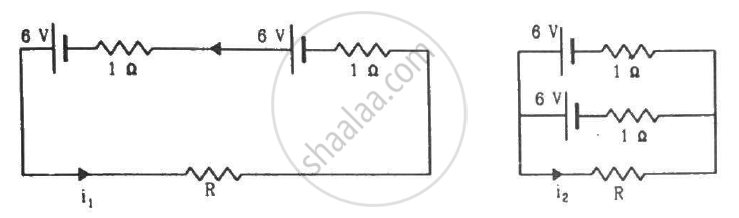
Find the value of i1/i2 in the following figure if (a) R = 0.1 Ω (b) R = 1 Ω and (c) R = 10 Ω. Note from your answers that in order to get more current from a combination of two batteries, they should be joined in parallel if the external resistance is small and in series if the external resistance is large, compared to the internal resistance.
A cell having an emf E and internal resistance r is connected across a variable external resistance R. As the resistance R is increased, the plot of potential difference V across R is given by ______.
If n cells each of emf e and internal resistance r are connected in parallel, then the total emf and internal resistance will be ______.
Five cells each of emf E and internal resistance r send the same amount of current through an external resistance R whether the cells are connected in parallel or in series. Then the ratio `("R"/"r")` is:
The internal resistance of a cell is the resistance of ______
A cell E1 of emf 6 V and internal resistance 2 Ω is connected with another cell E2 of emf 4 V and internal resistance 8 Ω (as shown in the figure). The potential difference across points X and Y is ______.

When a cell is short-circuited (R = 0), the maximum current that can flow is:
