Advertisements
Advertisements
प्रश्न
Two cells of emf E1, E2 and internal resistance r1 and r2 respectively are connected in parallel as shown in the figure.
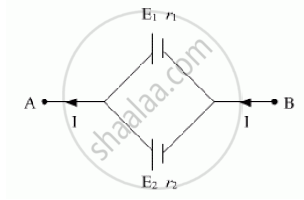
Deduce the expressions for
(1) the equivalent e.m.f of the combination
(2) the equivalent resistance of the combination, and
(3) the potential difference between the point A and B.
Advertisements
उत्तर

Let I1 and I2 be the current in two cells with emf E1 and E2 and internal resistance r1 and r2
So I = I1 + I2
Now let V be the potential difference between the points A and B. Since the first cell is connected between the points A and B.
V = potential difference across first cell
V = E1 − I1r1
`or I_1 =(E_1-V)/r_1`
Now, the second cell is also connected between the points A and B. So,
`or I_2 =(E_2-V)/r_2`
Thus, substituting for I1 and I2
`I =(E_1-V)/r_1 + (E_2-V)/r_2`
`or, I (E_1 /r_1 + E_2 /r_2)-V(1 /r_1 +1 /r_2)`
`V =((E_1r_2 + E_2r_1)/(r_1+r_2)) -I((r_1r_2)/(r_1 +r_2)) ..... (1)`
If E is effective e.m.f and r, the effective internal resistance of the parallel combination of the two cells then V = E − Ir …..(2)
Comparing (1) and (2)
`(1) E= (E_1r_2 + E_2r_1)/(r_1+r_2)`
This is equivalent e.m.f of the combination
`(2)r =(r_1r_2)/(r_1 +r_2)`
This is equivalent resistance of the combination.
(3) The potential difference between the point A and B is
V = E − Ir
संबंधित प्रश्न
The storage battery of a car has an emf of 12 V. If the internal resistance of the battery is 0.4 Ω, what is the maximum current that can be drawn from the battery?
In a potentiometer arrangement, a cell of emf 1.25 V gives a balance point at 35.0 cm length of the wire. If the cell is replaced by another cell and the balance point shifts to 63.0 cm, what is the emf of the second cell?
Answer the following question.
A cell of emf E and internal resistance r is connected across a variable resistor R. Plot the shape of graphs showing a variation of terminal voltage V with (i) R and (ii) circuit current I.
Study the two circuits shown in the figure below. The cells in the two circuits are identical to each other. The resistance of the load resistor R is the same in both circuits.

If the same current flows through the resistor R in both circuits, calculate the internal resistance of each cell in terms of the resistance of resistor R. Show your calculations.
The terminal voltage of the battery, whose emf is 10 V and internal resistance 1 Ω, when connected through an external resistance of 4 Ω as shown in the figure is:
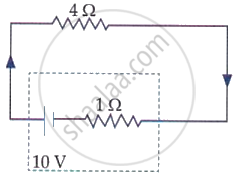
The relationship between terminal potential difference (V), EMF (ε), current (I), and internal resistance (r) is given by:
During discharging of a cell, the current direction flows out of:
During discharging, chemical energy is converted to:
During charging, electrical energy is converted to:
