Advertisements
Advertisements
प्रश्न
A long straight current carrying wire passes normally through the centre of circular loop. If the current through the wire increases, will there be an induced emf in the loop? Justify.
Advertisements
उत्तर
No, there will be no induced emf in the loop as there is no change in the magnetic flux linked with the circular loop because magnetic field lines are parallel to the plane of the loop.
ϕ=B.A
As the angle between the field line and the area vector is 90 degrees, we have zero flux linked with the loop.
ϕ=BAcosθ
ϕ=BAcos90°ϕ=0
APPEARS IN
संबंधित प्रश्न
Two cells of emfs 1.5 V and 2.0 V, having internal resistances 0.2 Ω and 0.3 Ω, respectively, are connected in parallel. Calculate the emf and internal resistance of the equivalent cell.
Six lead-acid types of secondary cells each of emf 2.0 V and internal resistance 0.015 Ω are joined in series to provide a supply to a resistance of 8.5 Ω. What are the current drawn from the supply and its terminal voltage?
The equivalent resistance between points. a and f of the network shown in Figure 2 is :
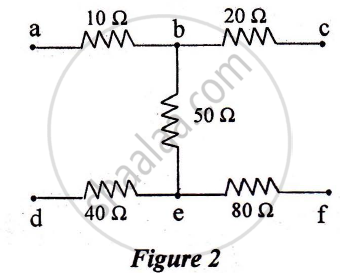
a) 24 Ω
b) 110 Ω
c) 140 Ω
d) 200 Ω
A conductor of length ‘l’ is rotated about one of its ends at a constant angular speed ‘ω’ in a plane perpendicular to a uniform magnetic field B. Plot graphs to show variations of the emf induced across the ends of the conductor with
- angular speed ω and
- length of the conductor l.
A cell having an emf E and internal resistance r is connected across a variable external resistance R. As the resistance R is increased, the plot of potential difference V across R is given by ______.
A block of metal is heated directly by dissipating power in the internal resistance of block. Because of temperature rise, the resistance increases exponentially with time and is given by R(t) = 0.5 e2t, where t is in second. The block is connected across a 110 V source and dissipates 7644 J heat energy over a certain period of time. This period of time is ______ × 10-1 sec (take ln 0.367 = -1).
The emf of a cell is defined as the work done in carrying a unit positive charge through which part of the circuit?
When a cell is short-circuited (R = 0), the maximum current that can flow is:
During charging, electrical energy is converted to:
Internal resistance of a cell is affected by the surface area of electrodes. As surface area increases, internal resistance:
