Advertisements
Advertisements
प्रश्न
A cell of emf E is connected across an external resistance R. When current 'I' is drawn from the cell, the potential difference across the electrodes of the cell drops to V. The internal resistance 'r' of the cell is ______.
विकल्प
`((E - V)/E)R`
`((E - V)/R)`
`((E - V)R)/I`
`((E - V)/V)R`
Advertisements
उत्तर
A cell of emf E is connected across an external resistance R. When current 'I' is drawn from the cell, the potential difference across the electrodes of the cell drops to V. The internal resistance 'r' of the cell is `underlinebb(((E - V)/V)R)`.
Explanation:
The electromotive force (e) or e.m.f. is the energy provided by a cell or battery per coulomb of charge passing through it. It is measured in volts (V). It is equal to the potential difference across the terminals of the cell when no current is flowing through it. E = I(R + r), where E = electromotive force in volts, I = current in amperes, R = resistance of the load in the circuit in ohms, and r = internal resistance of the cell in ohms. That is, E = IR + Ir, E = V + Ir.
Rearranging the equation we get,
r = `((E - V))/I`
Substituting `I = V/R` in the above equation, we get,
r = `((E - V)R)/V`
∴ Internal resistance, r = `((E - V)R)/V`
संबंधित प्रश्न
Nichrome and copper wires of same length and same radius are connected in series. Current I is passed through them. Which wire gets heated up more? Justify your answer.
Can the potential difference across a battery be greater than its emf?
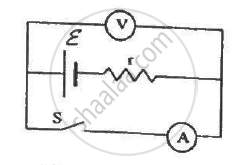
The following figure shows an arrangement to measure the emf ε and internal resistance r of a battery. The voltmeter has a very high resistance and the ammeter also has some resistance. The voltmeter reads 1.52 V when the switch S is open. When the switch is closed, the voltmeter reading drops to 1.45 V and the ammeter reads 1.0 A. Find the emf and the internal resistance of the battery.
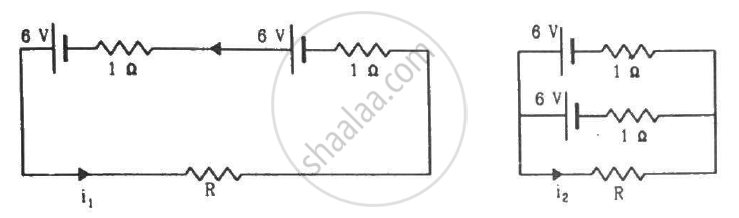
Find the value of i1/i2 in the following figure if (a) R = 0.1 Ω (b) R = 1 Ω and (c) R = 10 Ω. Note from your answers that in order to get more current from a combination of two batteries, they should be joined in parallel if the external resistance is small and in series if the external resistance is large, compared to the internal resistance.
Find the emf of the battery shown in the figure:
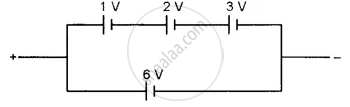
Answer the following question.
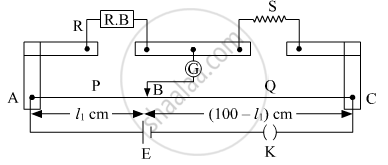
What is the end error in a meter bridge? How is it overcome? The resistances in the two arms of the metre bridge are R = Ω and S respectively. When the resistance S is shunted with equal resistance, the new balance length found to be 1.5 l1, where l2 is the initial balancing length. calculate the value of s.
A conductor of length ‘l’ is rotated about one of its ends at a constant angular speed ‘ω’ in a plane perpendicular to a uniform magnetic field B. Plot graphs to show variations of the emf induced across the ends of the conductor with
- angular speed ω and
- length of the conductor l.
Two batteries of emf ε1 and ε2 (ε2 > ε1) and internal resistances r1 and r2 respectively are connected in parallel as shown in figure.

During charging of a cell, the terminal potential difference formula is:
During discharging, chemical energy is converted to:
